Table of Contents
- Why Workflow Is the Backbone of Kitchen Operations
- What Is a Commercial Kitchen Workflow?
- Core Stages in a Commercial Kitchen Workflow
- How Workflow Differs Across Kitchen Types
- Common Workflow Bottlenecks and Their Impact
- How Commercial Kitchen Workflow Improves Efficiency and Compliance
- How to Design the Right Workflow for Your Operation
- Frequently Asked Questions
- Final Thoughts and Practical Takeaways
Why Workflow Is the Backbone of Kitchen Operations
The workflow in commercial kitchens is the first thing I consider when evaluating food operations, followed by space or equipment. The explanation is straightforward. The efficiency with which people, food, and information flow through the kitchen is determined by workflow.
Congestion, delays, increased labor expenses, and hazards to food safety are all consequences of a poorly designed process. According to research on hospitality operations, one of the main reasons for productivity loss in professional kitchens is ineffective job sequencing and needless personnel movement. By minimizing redundant movement and task overlap, optimized workflows can increase operational efficiency by 20 to 30%, according to research cited by hospitality design institutes.
For this reason, it is essential to comprehend commercial kitchen operations. It is essential to managing a dependable, expandable food business.
What Is a Commercial Kitchen Workflow?
The term “commercial kitchen workflow” refers to the organized flow of tasks that food, personnel, and equipment go through from the time ingredients are brought into the kitchen until completed dishes are taken out.
In actuality, uniformity between teams and service times is guaranteed by a clearly defined professional kitchen workflow.
The workflow of food, personnel, and equipment in a professional kitchen is depicted in the below diagram.
The steps of a typical commercial kitchen process are as follows:
- Receiving and storing
- Getting Ready
- Preparing food
- Plating or holding
- Service or dispatch
- Waste management and cleaning
A well-planned workflow aims to minimize backtracking by ensuring that each step is completed in the proper sequence and location. This arrangement promotes efficiency, security, and uniformity throughout service times in professional kitchen settings.
Core Stages in a Commercial Kitchen Workflow
In my experience, even though the scale and architecture may vary, every effective commercial kitchen workflow adheres to the same fundamental steps.
Receiving and storage
When raw materials are delivered, workflow starts. To cut down on handling time and exposure, best practices advise locating storage spaces near reception points. To uphold food safety regulations, cold, frozen, and dry storage must be clearly separated.
Preparation
Washing, chopping, marinating, and portioning are all part of the preparation phase. Preparation spaces should be kept near storage to increase efficiency and lower the danger of contamination. At this point, the separation of raw and ready-to-eat preparation zones is emphasized by food safety regulations.
Cooking
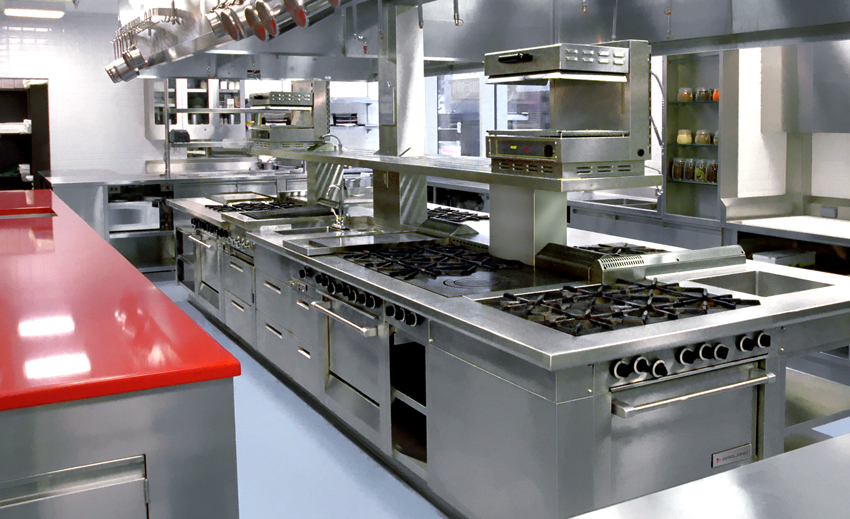
The most time-sensitive and heat-intensive step is cooking. In order to effectively manage heat and pollutants, equipment is typically grouped under shared ventilation systems. Clustering cooking equipment enhances supervision and minimizes mobility during peak operations, according to industry layout guidelines. Clustered cooking lines minimize supervision gaps and needless personnel mobility when compared to dispersed equipment arrangements.
Plating or holding
After cooking, food is either moved to holding facilities for batch serving or plating for instant serve. Quality control and quicker service handoff are supported by a clear division between cooking and plating.
Dispatch or service
Food is transported to service counters in dine-in establishments. It shifts to packing and dispatch zones in delivery-focused enterprises. Delivery procedures put speed and accurate packaging ahead of presentation, in contrast to restaurant service methods. Making this distinction is essential to creating a delivery kitchen process that is effective.
Cleaning and waste management
Waste disposal and dishwashing complete the process. In order to prevent cross-contamination, hygiene regulations emphasize that unclean operations must never overlap pathways used for food preparation.
How Workflow Differs Across Kitchen Types
Commercial kitchen workflow execution varies greatly depending on the commercial kitchen model, but workflow steps stay the same.
Workflow in restaurant kitchens strikes a balance between presentation and quickness. It is essential that the kitchen and service teams work together.
Workflow is streamlined and linear in delivery-focused configurations. Delivery kitchens put order accuracy and dispatch speed ahead of plating space, in contrast to dine-in kitchens. While cloud kitchens do away with plating and service coordination in favor of quick dispatch, restaurant kitchens set aside room for these processes.
Workflow is batch-oriented in large-scale settings like a central manufacturing kitchen. In contrast to service kitchens, these facilities prioritize cold chain control, consistency, and documentation over quick service.
When creating commercial kitchen solutions that actually support operations, it is crucial to comprehend these distinctions.
Common Workflow Bottlenecks and Their Impact
I frequently observe that the same process problems result in considerable operational stress and lost productivity across projects.
Crossing the path
Contamination risk rises and inspections become more challenging when raw food, prepared food, and filthy utensils cross movement paths.
Inadequate station sequencing
Employees waste time moving instead of producing if preparation is far from cooking or plating is far from service exits.
Overworked areas
Error rates are higher and output is slower during peak hours due to congestion.
Poor workflow design is directly linked to greater labor expenses and uneven service delivery, according to operational research in foodservice management.
How Commercial Kitchen Workflow Improves Efficiency and Compliance
A well-designed workflow delivers measurable benefits.
Improved productivity
Reducing unnecessary movement allows staff to focus on core tasks. This directly impacts output per labour hour.
Stronger food safety compliance
Clear separation of raw, cooked, and waste workflows aligns with global food safety frameworks such as HACCP, which emphasise control at each stage of food handling.
Lower operating costs
Efficient workflows reduce overtime, rework, and equipment misuse.
Better staff morale
Predictable workflows reduce stress and confusion during peak service periods.
These outcomes reinforce why commercial kitchen workflow planning is central to end-to-end kitchen operations.
How to Design the Right Workflow for Your Operation
Benefits from a well-designed workflow are quantifiable.
Increased output
Staff members can concentrate on their primary responsibilities by minimizing needless movement. The output per labor hour is directly impacted by this.
Enhanced adherence to food safety regulations
Workflows that clearly distinguish between raw, cooked, and waste are in line with international food safety frameworks like HACCP, which place a focus on control at every stage of food handling.
Reduced operating expenses
Workflows that are efficient minimize overtime, rework, and equipment misuse.
Increased employee morale
During instances of high service demand, predictable workflows lessen anxiety and confusion.
These results highlight the need for workflow planning in commercial kitchens for end-to-end kitchen operations.
Frequently Asked Questions
When designing a kitchen workflow, what is the first step?
Begin by outlining the steps involved in preparing each menu item from receipt to serving.
Is it possible for process to overcome space constraints?
Indeed. Even in little kitchens, performance can be greatly increased with clever zoning and sequencing.
What impact does workflow have on food safety?
Contamination hazards are decreased when raw, cooked, and trash pathways are well separated.
Is kitchen layout the same as workflow?
No. Workflow determines how jobs, food, and personnel actually move through a commercial kitchen, while layout supports it.
Does planning a workflow lower expenses?
Indeed. Workflows that are efficient cut down on errors, labor hours, and operational friction.
Anyone who is serious about food operations must understand the workflow of commercial kitchens. Staffing, layout, and equipment only function well when workflow is precisely established and regularly adhered to.
If you want your kitchen to operate efficiently, safely, and at scale, start with workflow design. Everything else comes into place when process is well designed, including customer happiness and compliance.