Table of Contents
- Why Hygiene Is Non-Negotiable in Commercial Kitchens
- What Are Commercial Kitchen Hygiene Guidelines?
- Personal Hygiene Standards for Kitchen Staff
- Kitchen Cleaning and Sanitation Protocols
- Equipment and Surface Hygiene Requirements
- Food Storage and Handling Hygiene Practices
- Role of Maintenance in Long-Term Hygiene Compliance
- Common Hygiene Failures and How to Prevent Them
- Frequently Asked Questions
- Final Thoughts and Operational Takeaways
Why Hygiene Is Non-Negotiable in Commercial Kitchens
I always prioritize hygiene when assessing professional kitchens, before equipment, workflow, or output.
Commercial kitchens face constant pressure. Without clear, enforced hygiene procedures, high volumes, rapid movement, and shared workstations increase the risk of contamination.
Poor hygiene leads to failed inspections, foodborne illness, equipment damage, pest infestations, employee absences, and long-term brand harm. Kitchens that focus on cleanliness every day perform better, have fewer shutdowns, and keep customer trust.
For this reason, regardless of size or structure, every food business must understand and comply with commercial kitchen hygiene regulations.
What Are Commercial Kitchen Hygiene Guidelines?
The systematic techniques, processes, and maintenance standards intended to maintain clean, safe, and contamination-free food preparation facilities are referred to as commercial kitchen hygiene guidelines.
Usually, these rules address:
- Staff personal hygiene habits for cleaning and sanitization
- Surface hygiene and equipment
- Safe handling and storage of food
- Pest control and waste management
Due to the direct involvement of public health, cleanliness standards in professional kitchens are universally stringent, notwithstanding regional variations in regulations.
I’ve found that kitchens that approach hygiene as a system rather than a checklist have far easier time maintaining compliance.
Personal Hygiene Standards for Kitchen Staff
The first line of defense against infection is staff hygiene.
The following should be enforced in any professional kitchen:
- Every day, fresh uniforms or aprons are changed.
- Hair restrictions like hairnets or caps
- Handwashing on a regular basis at designated locations
- No watches, jewelry, or loose accessories
- Unambiguous guidelines for reporting and excluding illnesses
Particularly important is hand hygiene. Before handling food, after handling raw materials, after cleaning duties, and following any action that could lead to contamination, staff members are required to wash their hands.
If staff procedures are inconsistent, even the best-designed kitchen will not meet sanitary standards.

Kitchen Cleaning and Sanitation Protocols
Cleaning and sanitizing are both necessary, but not the same thing.
Cleaning removes grease and visible dirt. Hazardous bacteria are reduced to safe levels through sanitization. Professional kitchens need to accomplish both.
Good hygiene practices consist of:
- Schedules for daily, weekly, and thorough cleaning were recorded.
- Using cleaning agents that are safe for food
- Various zones require various cleaning supplies.
- Clearly assigned responsibilities for every task.
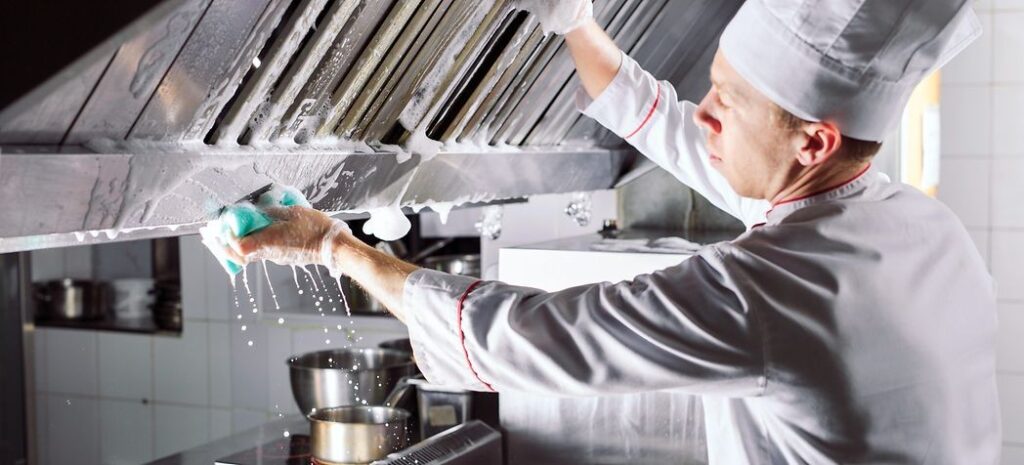
High-risk areas such as prep tables, cutting boards, sinks, and cooking lines need regular cleaning during service, not just at closing.
Because hygiene cannot be consistently demonstrated, kitchens without organized cleaning schedules often fail inspections.
Equipment and Surface Hygiene Requirements
Maintenance and equipment hygiene are strongly related.
Every surface that comes into contact with food must be:
- Non-porous and simple to clean
- Devoid of corrosion, peeling coatings, or fissures
- Cleaned in between jobs
Mixers, slicers, refrigerators, and cooking ranges are examples of equipment that needs to be cleaned in accordance with manufacturer instructions. Grease accumulation, bacterial growth, and early equipment failure are frequently caused by improper cleaning.
Accessibility for cleaning is as crucial as performance, as the equipment hygiene zones above demonstrate.
Food Storage and Handling Hygiene Practices
Safe food handling is a basic rule in commercial kitchen hygiene.
Important procedures consist of:
- Keeping cooked and raw food separate
- Storage containers with clear labels
- Freezers and refrigeration systems with temperature control
- Inventory rotation based on first-in, first-out
One of the most common hygienic infractions I encounter is improper storage. Contamination risk is increased by unlabeled containers, overfilled refrigerators, and raw foods kept above cooked foods.
Good hygiene requires discipline as much as proper infrastructure.
Role of Maintenance in Long-Term Hygiene Compliance
Hygiene doesn’t end with cleaning. Ongoing maintenance is essential.
Unmaintained kitchens lead to:
- Pipes that leak and draw bugs
- Tiles with cracks that harbor germs
- Food safety is compromised by malfunctioning refrigeration.
- Grease buildup in hood systems
Regular maintenance and post-purchase assistance guarantee that commercial kitchen hygienic standards are maintained over time. I’ve found that kitchens with organized maintenance schedules encounter fewer equipment malfunctions and hygienic issues.
This is the point at which operating efficiency, safety, and hygiene come together.
Common Hygiene Failures and How to Prevent Them
Inspections consistently reveal the same hygienic problems.
Typical mistakes consist of:
- Handwashing techniques that are inconsistent
- Inadequate waste segregation and infrequent deep cleaning of equipment
- Grease traps and drains that are neglected
- Absence of cleaning records
With well-defined SOPs, frequent training, and planned maintenance, the majority of these problems may be avoided.
Frequently Asked Questions
Are all commercial kitchens need to adhere to sanitary regulations?
Indeed. Compliance with hygiene regulations is necessary for licensing and ongoing business operations.
How frequently should a commercial kitchen get a thorough cleaning?
Deep cleaning should be planned on a regular basis in addition to daily cleaning, albeit the frequency will depend on consumption.
Are small kitchens subject to hygienic regulations?
Of course. Due to space limitations, smaller kitchens frequently have higher hygiene risks.
Who is in charge of upholding hygienic standards?
With the help of qualified personnel and maintenance partners, the operator is in charge.
Can hygiene inspections be impacted by inadequate maintenance?
Indeed. Hygiene results are directly impacted by facility maintenance and equipment condition.
Final Thoughts and Operational Takeaways
Commercial kitchen hygiene guidelines are not theoretical rules. They are daily operational disciplines.
When hygiene is built into staff behavior, cleaning routines, and maintenance planning, kitchens operate more smoothly, and inspections become routine rather than stressful.
If you want long-term compliance, focus not only on cleaning but also on systems, training, and after-sales support. Hygiene done right protects customers, staff, equipment, and brand value.