Table of Contents
• Why Planning Determines Project Success
• What Strategic Kitchen Planning Involves
• Defining Menu, Volume, and Operational Flow
• Utility and Load Assessment Strategy
• Compliance and Regulatory Alignment
• Budgeting and Procurement Planning
• Sequencing and Installation Roadmap
• Frequently Asked Questions
• Final Thoughts and Strategic Takeaways
Why Planning Determines Project Success
Kitchen project success depends on thorough planning. Focusing only on plans and equipment can lead to missed details.
Unconfirmed early decisions can cause project delays, such as changes in electrical panels, ventilation ducts, or compliance approvals.
The quality of your preparation will determine whether the execution will be smooth or corrective. Strong commercial kitchen project planning tends to reduce uncertainty before installation begins.
What Strategic Kitchen Planning Really Means
Strategic kitchen planning is more than picking equipment. It means considering how the space will work every day before buying anything. Operations, utilities, compliance, workflow, and installation all need to fit together from the very beginning.
Good planning typically means:
- Understanding your service style and projected output, and designing around realistic production volumes
- Clearly separating prep, cooking, plating, and cleaning zones to avoid bottlenecks and cross-traffic
- Confirming that power, gas, water, and drainage systems can handle peak demand, with backup capacity where necessary
- Factoring in how equipment will operate simultaneously when calculating ventilation and extraction needs
- Including regulatory checks in the layout instead of leaving compliance until the end
Basically, this process combines equipment layout with a close look at infrastructure to ensure the kitchen can handle real busy times, not just plans on paper.

Defining Menu, Volume, and Operational Flow
The first step is to define the menu and expected service volume that is required.
Before listing equipment, it’s important to clarify:
- Hourly anticipated coverage during peak service
- Common cooking techniques
- Continuous versus batch cooking
- Movement zones and staffing patterns
Different types of kitchens require different ventilation and power planning, depending on the menu and service style. Equipment configuration should match operational needs.
Minimising cross-movement in the workflow helps reduce traffic and the risk of contamination. Each stage, raw material entry, preparation, cooking, plating, and dish return, should follow a logical sequence.
The physical layout should be designed to support operational needs.
Operational requirements should guide the design of the physical layout.
Utility and Load Assessment Strategy
Utility validation is a critical step for safety and functionality.
Before finalising specifications, it’s important to confirm:
- The distribution authority approved the electrical load.
- Capacity of transformers and panels with buffer margins
- The sizing of gas lines for the simultaneous peak demand
- Sufficient water storage
- The viability of drainage flow
- For the worst-case cooking load, exhaust airflow
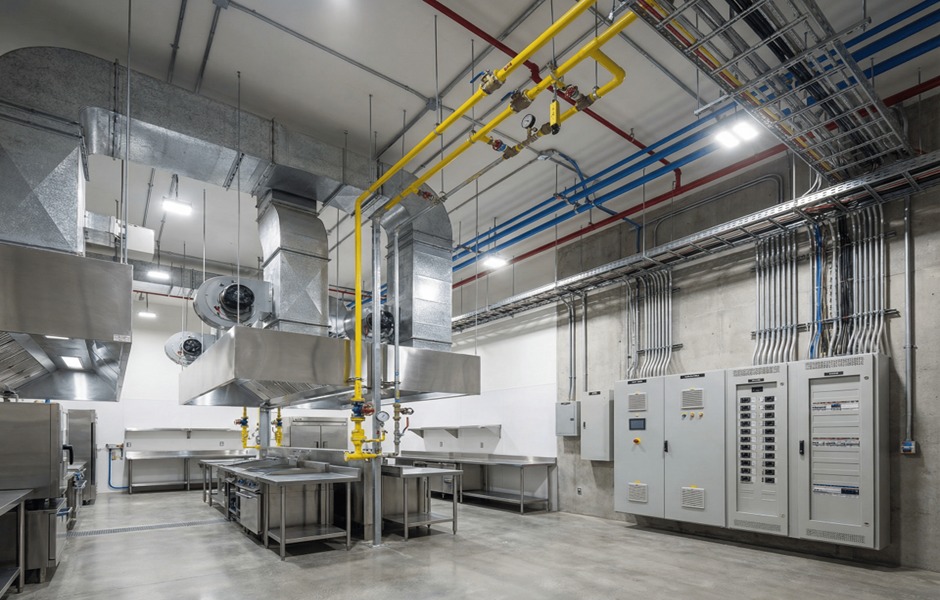
In India, infrastructure upgrades may be needed if electrical approvals are insufficient. PESO safety standards apply to LPG installations, and exhaust systems must follow the National Building Code for fire safety.
Making changes after equipment is purchased can be costly if utilities are not validated early.
Compliance and Regulatory Alignment
Compliance is an essential part of planning and affects layout decisions.
Commercial kitchens need to adhere to:
- Schedule 4 hygiene infrastructure standards of the FSSAI
- NOC circumstances for the fire department
- Requirements for municipal trade licenses
- Egress and structural safety regulations
For example, if raw and cooked zones are not properly separated, FSSAI approval can be delayed. Similarly, fire approvals may be affected by issues with exhaust ducts.
Including compliance checks in the design review process helps prevent last-minute changes.
Budgeting and Procurement Planning
Clear technical specifications are important for effective budgeting.
Budgets can increase due to:
- Modifications to equipment specifications after the fact
- Resizing ventilation
- Improvements to electrical panels
- Reinforcing structures
Procurement decisions should be based on verified engineering data, not assumptions.
The original budget should include costs for commissioning, validation, and paperwork. Overlooking these expenses can result in rushed project completion.
Sequencing and Installation Roadmap
Project planning should follow a logical sequence.
A well-organised roadmap consists of:
- Rough-in and service routing
- Installing ducts and ventilation
- Positioning of equipment, Alignment of stainless steel manufacturing
- Connections to utilities
- Validation and load testing
Poor sequencing can cause rework and congestion on-site. Following a set roadmap helps avoid last-minute changes during execution.
Frequently Asked Questions
When should the planning process start?
Before completing leasing agreements and civil layout.
Can intricate planning be avoided in small kitchens?
No, a lack of space makes coordination more sensitive.
How thorough ought load validation to be?
It needs to account for concurrent peak operation.
Does cost reduction come from early planning?
Yes, early planning avoids delays in inspections and infrastructure redesign.
Who ought to be in charge of planning?
An execution partner primarily focuses on regulatory and technical expertise.
Final Thoughts and Strategic Takeaways
Effective commercial kitchen project planning requires integration and careful preparation.
When workflow, budgets, utilities, menu planning, sequencing, and compliance are aligned early, project execution becomes more predictable. Lack of preparation can lead to errors during installation.
Treating commercial kitchen project planning as a technical discipline from the start leads to smoother commissioning and fewer operational surprises.
Budgeting is a core part of that discipline; our breakdown of commercial kitchen cost in India covers realistic per-square-foot ranges by kitchen tier.