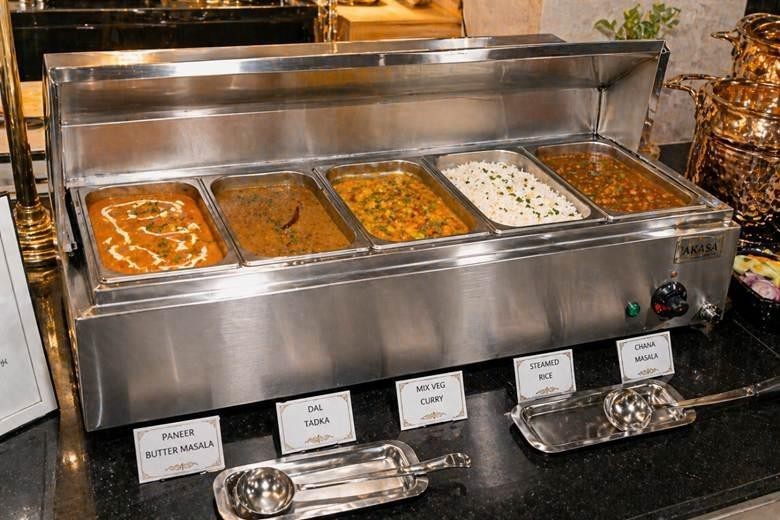
If you run a catering business, manage a hotel banquet, or oversee a restaurant buffet in India, you already know the problem. Food sits out for longer than it should, the dal starts to thicken, the curry loses its colour, and by the time the last table is served, quality has taken a hit. A commercial bain marie solves that; it is the one piece of equipment that keeps pre-cooked food at the right serving temperature for hours, without drying it out or overcooking it.
In simple terms, a bain marie is a food warmer that uses gentle, indirect heat; either through hot water or dry heating elements – to hold dishes at safe, consistent temperatures. You will see them at every serious hotel buffet, catering event, or QSR pass station in the country. And yet, a lot of buyers still make the wrong choice; wrong type, wrong capacity, wrong power source; because they do not fully understand what the options are.
This guide is meant to change that. I will walk you through everything: how a bain marie works, the real difference between wet and dry variants, how to size capacity for your setup, what temperatures to maintain, and what you should expect to pay in India in 2024.
What Is a Bain Marie and How Is It Used in Commercial Kitchens?
The term bain marie comes from French, loosely meaning “water bath.” The concept is old; really old. It traces back to Maria Prophetissa, an alchemist who reportedly used a water-heating method to maintain gentle, even temperatures. Commercial kitchens took that principle and turned it into one of the most dependable pieces of service equipment on the floor.
At its core, a commercial bain marie works like this: food containers; typically GN (gastronorm) pans; sit inside a heated well or above a water bath. The heat source warms the water or the air around the food pans, and that indirect warmth holds the food at the right temperature without direct flame or element contact. The result is that sauces stay smooth, gravies retain their consistency, and dishes stay visually and texturally intact through long service periods.
In Indian commercial kitchens especially, this matters a great deal. Dal, butter chicken, sambhar, biryani accompaniments, rasam; these are dishes that either overcook quickly under direct heat or go cold and unappetising when left at room temperature. A bain marie sits right in the middle, holding them exactly as they should be served.
The equipment typically comes with stainless steel GN pans (1/1, 1/2, 1/3 sizes depending on the model), a thermostat for temperature control, and sometimes individual well controls if you are running a multi-well unit. For hotels and banquets, it doubles as a display counter piece; presentable, clean, and functional at the same time.
Beyond buffet use, bain maries are also used in central kitchens and cloud kitchen setups for holding prepped sauces and bases before dispatch. And in pastry sections, chefs rely on wet heat models specifically for melting chocolate, making custards, and preparing hollandaise or sabayon, where direct heat would ruin the emulsion entirely.
Wet Bain Marie vs Dry Bain Marie: What Is the Actual Difference?
This is probably the question I get asked most often, and honestly the answer is more practical than technical. Both types keep food warm. The difference is in how they do it; and that matters a lot depending on what you are serving.
Wet Heat Bain Marie
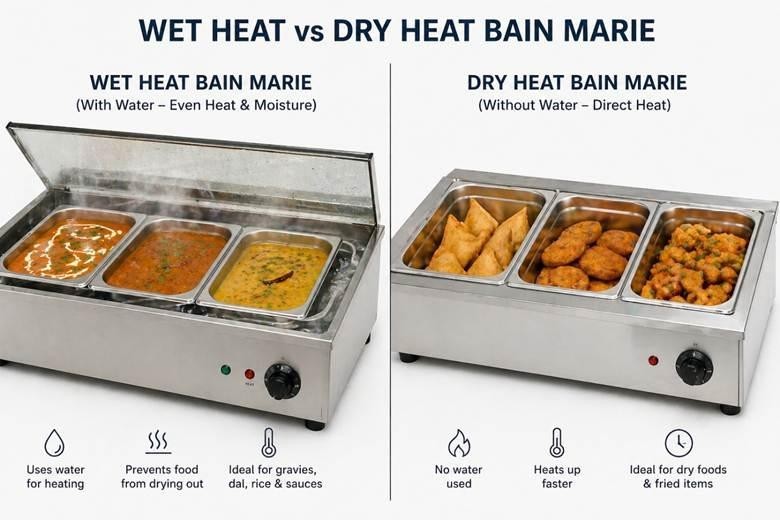
In a wet heat bain marie, the food pans sit inside or above a water bath. The water is heated by an immersion element or a gas burner, and that hot water surrounds the base and sides of the GN pans. The indirect, moist heat is extremely gentle; the water cannot exceed 100 degrees Celsius, which means there is a physical ceiling on how hot the food can get.
This is ideal for delicate preparations: Indian gravies, cream-based curries, custards, hollandaise, chocolate, beurre blanc, and any sauce that splits or curdles under direct heat. The steam from the water also keeps the food from drying out on the surface, which is
important during long buffet services. For a hotel running a 3-hour breakfast buffet or a 4-hour wedding banquet, wet heat is usually the smarter choice.
The tradeoff? Wet bain maries take longer to heat up. You need to plan for 20 to 30 minutes of preheat time. They also require you to monitor water levels; run them dry and the element burns out. Cleaning is slightly more involved because you need to drain and wipe down the water well after each service.
Dry Heat Bain Marie
Dry heat models use a heating element that sits below the food pans without any water involved. The element heats up quickly; often ready to use in under 10 minutes; which makes dry heat variants popular in QSR setups, mobile catering, and canteen counters where speed is important.
They are also more energy-efficient in one sense: there is no large volume of water to keep hot. Staff find them easier to manage, and since there is no hot water involved, the risk of steam burns or accidental spillage is lower. For fried foods, finger foods, baked snacks, or anything with a crust you want to preserve, dry heat is better because wet steam would soften it.
The downside is real though. Dry heat can be uneven; the element positioning on some models means certain parts of the food pan get hotter than others. And without steam, gravies and sauces can dry out or develop a skin at the surface during extended holding. For delicate Indian preparations, this is a genuine concern.
Quick Comparison
| Factor | Wet Heat Bain Marie | Dry Heat Bain Marie |
| Heat Method | Hot water bath (indirect) | Heating element (direct) |
| Preheat Time | 20 to 30 minutes | 5 to 10 minutes |
| Best For | Gravies, sauces, curries, custards | Fried items, snacks, bread-based foods |
| Moisture Retention | Excellent; steam keeps food moist | Lower; food can dry out |
| Energy Use | Higher (water heating) | Lower (no water) |
| Maintenance | Needs draining, limescale care | Easier to clean and maintain |
| Common Use in India | Hotel buffets, banquet halls, catering | QSRs, canteens, fast food counters |
One thing worth noting: some models in the market today are designed to switch between wet and dry operation. The heating elements are sealed, so you can use the same unit both ways depending on the day’s menu. If your kitchen serves a varied menu, that kind of flexibility is worth paying a little extra for.
How Many Pots Does a Commercial Bain Marie Need for a Hotel Banquet?
Sizing a bain marie is where most buyers make mistakes. The instinct is usually to go bigger, but that is not always the right call either. The real question is: how many dishes are you holding at once, and for how long?
Let me break it down by operation type, based on industry norms and what we see most often at Jacio Indicius when helping clients choose the right setup.
For Restaurants and QSRs
A standard restaurant buffet or a la carte pass typically needs 3 to 5 GN pans running at a time. A countertop 3-pot or 4-pot bain marie is usually sufficient. At the pass, you might have one or two additional bain marie positions for sauces or garnishes. The key here is compact footprint; counter space is premium in most Indian restaurant kitchens.
For Catering Operations
Mobile catering for events of 100 to 300 covers typically requires 4 to 6 pots minimum, running 3 to 4 dishes simultaneously with backup capacity. Mobile bain maries on wheels are popular here because the setup moves. If you are catering outdoors, a gas-powered mobile unit makes more sense than electric, since you cannot always guarantee stable power at event venues.
For Hotel Buffets and Banquet Halls
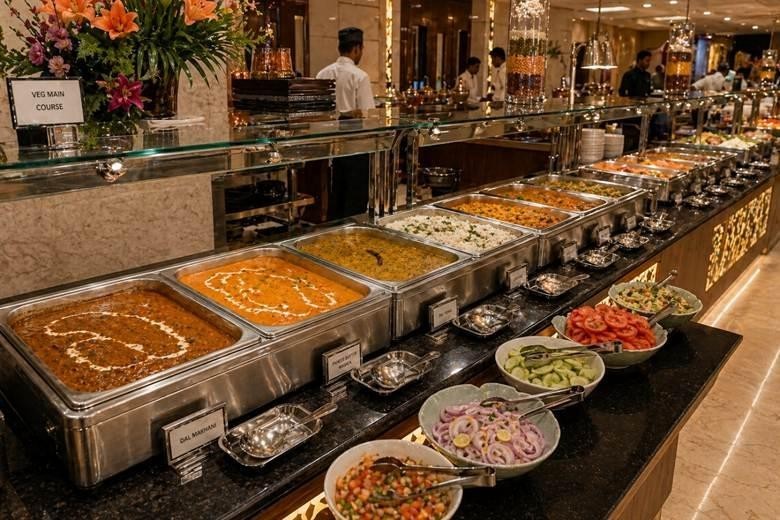
This is where sizing really matters. A hotel banquet serving 300 to 500 guests across a lunch or dinner service would typically run 8 to 12 GN pans across multiple bain marie counters.
For a full Indian spread; rice, 2 to 3 curries, dal, sambar, 1 to 2 dry sabzis, raita accompaniments, and perhaps a soup kettle; you are looking at a minimum of 8 positions, likely split across two bain marie counters.
Standard GN pan sizes to know:
- 1/1 GN pan (530 x 325 mm); holds approximately 20 litres, suitable for main curries and dal
- 1/2 GN pan (265 x 325 mm); holds approximately 10 litres, good for side dishes
- 1/3 GN pan (176 x 325 mm); holds approximately 6 litres, used for chutneys, raita, accompaniments
A soup kettle; essentially a high-capacity wet heat unit; is a separate category used for holding large quantities of a single liquid item like rasam, soup, or thin dal. These are standalone round pots, typically 10 to 15 litres, and are not part of the main bain marie counter.
For a hospital canteen or institutional kitchen serving 500 or more meals per day, a drop-in bain marie built into the servery counter is often the right call. These are plumbed in, larger in capacity, and designed for continuous service rather than portability.
What Is the Correct Temperature Setting for a Bain Marie Food Warmer?
Temperature is not just a quality question. It is a food safety requirement. In India, FSSAI guidelines align with global food safety standards: cooked food held for service must be maintained above 60 degrees Celsius to prevent bacterial growth. This is the “hot holding” standard.
In practice, most commercial bain maries are set between 65 and 85 degrees Celsius for standard hot holding. Here is a rough breakdown by food type:
- Indian curries, gravies, and dal; 70 to 80 degrees Celsius
- Rice and biryani; 65 to 70 degrees Celsius (lower to prevent drying)
- Soups and broths; 75 to 85 degrees Celsius
- Delicate sauces, custards, hollandaise; 60 to 65 degrees Celsius
- Fried items and snacks in dry heat bain maries; 70 to 75 degrees Celsius
The thermostat on a good commercial bain marie should hold temperature within plus or minus 2 to 3 degrees of the set point. Units with poor temperature control or inadequate insulation will cycle widely, which means some food gets too hot while other parts of the pan sit below safe temperatures.
One thing I always recommend: preheat the bain marie before placing the food in. Putting cold or warm food into an unheated unit and expecting it to come up to temperature quickly is a mistake. Depending on the model, preheat time ranges from 10 to 30 minutes. For hotel banquets especially, the unit should be running at temperature at least 20 minutes before service starts.
Also worth mentioning: most quality bain maries include a thermal cut-out. If the water level drops in a wet model, or if the temperature rises beyond a safe threshold in a dry model, the unit automatically shuts off. This protects the heating element and the food. After a cut-off, you simply refill the water (if applicable), allow the unit to cool, and press the reset button.
How Much Does a Commercial Bain Marie Cost in India?
Pricing varies quite a bit depending on the number of pots, the heating type, build quality, and whether the unit is countertop or mobile. Here is a realistic range based on what is available in the Indian market currently.
| Type | Capacity / Configuration | Approx. Price Range (INR) |
| Countertop Wet Heat | 3-pot / 3 x 1/3 GN pans | Rs. 12,000 to Rs. 22,000 |
| Countertop Dry Heat | 3 to 4 pot configuration | Rs. 10,000 to Rs. 18,000 |
| Countertop Wet Heat | 5 to 6 pot / larger GN | Rs. 22,000 to Rs. 40,000 |
| Mobile Bain Marie (Gas) | 4 to 6 pot, wheeled | Rs. 35,000 to Rs. 65,000 |
| Drop-in Bain Marie | Built-in, 4 to 8 wells | Rs. 45,000 to Rs. 1,20,000 |
| Hot Cupboard Bain Marie | Large format, mobile | Rs. 70,000 to Rs. 1,80,000 |
The gap between the cheapest and most expensive options is significant, and it is largely explained by three things: material quality, temperature consistency, and durability under daily commercial use.
Entry-level units use thinner gauge steel (sometimes 201 grade stainless) and simpler thermostats. They work fine for low-frequency use but tend to warp, corrode, or develop inconsistent heating over time. Commercial operations running daily service should invest in units built from 304-grade stainless steel, which is more resistant to corrosion from food acids, cleaning agents, and the humidity of an active kitchen.
At Jacio Indicius, we supply commercial bain maries designed specifically for the Indian market; factoring in voltage fluctuations, the nature of Indian cuisine (higher moisture content, longer holding times), and the kind of daily abuse that any serious kitchen puts equipment through. If you are not sure what configuration fits your operation, that is exactly the conversation we are set up to have.
Gas vs Electric Bain Marie: Which Should You Choose for Your Kitchen?
This is a practical question and the answer depends almost entirely on your kitchen setup. Both power sources work well; the choice is usually about infrastructure, cost of running, and service requirements.
Electric bain maries are easier to install and control. You plug them in, set the thermostat, and they heat consistently. They are the default choice for hotel servery counters, banquet buffet lines, and any indoor setup with stable power. Temperature control is precise, and modern electric models come with digital displays and individual well thermostats on multi-well units.
Gas bain maries heat up faster and are generally preferred for outdoor catering events, mobile setups, and kitchens in areas with unreliable power supply. They tend to cost a bit less to run if your commercial LPG connection is economical. The tradeoff is less precise temperature control compared to a well-calibrated electric unit, and they require more attention during service.
For most hotel kitchens and established restaurant setups in India, electric is the practical choice. For catering businesses that operate across venues; wedding lawns, farm venues, outdoor events; a gas-powered mobile unit gives you independence from the power grid.
Choosing the Right Bain Marie: A Practical Checklist
Before I wrap up, let me give you something you can actually use. These are the questions I would ask before recommending any unit to a client; whether they run a 30-cover restaurant or a 500-guest banquet facility.
- What type of food are you holding? Wet heat for gravies and sauces; dry heat for fried or baked items.
- How long is your average service window? Longer services benefit from wet heat and moisture retention.
- How many dishes do you hold simultaneously at peak? This directly determines the number of GN positions you need.
- Is your setup static (buffet counter) or mobile (catering events)? Mobile operations benefit from wheeled gas units.
- Do you have reliable power? If not, a gas model gives you operational independence.
- What is your cleaning routine? Wet bain maries need regular descaling; dry models are quicker to maintain.
- What is your budget for total cost of ownership; not just purchase price? Cheaper units may cost more in repairs and early replacement.
The right model is not always the biggest or the most expensive. It is the one that fits your service type, your kitchen layout, and the volume you realistically run.
Maintenance Tips That Actually Extend Equipment Life
A commercial bain marie that gets maintained properly can last 8 to 12 years with consistent daily use. One that is neglected rarely makes it past 3. Here is what matters most.
Daily: After each service, drain the water from wet heat units. Wipe down the interior wells and exterior surfaces while still warm (but not too hot). Do not leave standing water in the well overnight; it accelerates limescale buildup and corrosion.
Weekly: Descale the water well using a diluted food-safe descaling agent, particularly if your water supply is hard. Hard water is common in many parts of India, and limescale deposits on the heating element reduce efficiency and eventually cause failure.
Check GN pan fit regularly. A pan that sits loosely in the well allows heat to escape, leading to uneven holding temperatures and higher energy consumption. Make sure replacement pans match the GN sizing specified for your unit.
Never run a wet heat bain marie without water in the well. This is the single most common cause of heating element failure. Most quality units have an anti-dry protection feature, but it is not a substitute for correct water levels.
For more on when it makes sense to service versus replace commercial kitchen equipment, see our guide on
For more on when it makes sense to service versus replace commercial kitchen equipment, see our guide on understanding the lifespan of commercial kitchen equipment.
The Bottom Line
A commercial bain marie is not a glamorous piece of equipment. It does not cook anything. It does not transform a dish. What it does is protect the quality of food that your kitchen has already worked hard to prepare. In catering and hotel operations, that last mile; from kitchen to guest; is where quality is either preserved or lost.
Choosing the right bain marie means understanding your service type, your food, and your capacity requirements. It means not cutting corners on build quality when the unit will be
running through multiple services every day. And it means maintaining the equipment properly so it actually earns back its cost over years of reliable use.
At Jacio Indicius, we work with hotel kitchens, catering businesses, and restaurant operators across India to match them with the right commercial kitchen equipment for their specific setup; including a range of commercial bain maries suited to Indian cooking requirements and service volumes. If you want a recommendation or want to talk through what your operation needs, we are here for that conversation.
You may also find these useful: When to upgrade your commercial kitchen equipment | Energy efficiency in commercial kitchens | Safety considerations for commercial kitchen equipment
Frequently Asked Questions (FAQ)
What is a bain marie and how is it different from a regular food warmer?
A bain marie uses indirect heat; either a water bath or a carefully positioned heating element; to hold food at serving temperature. A regular food warmer typically uses direct heat, which can overcook, dry out, or burn delicate dishes. The bain marie is specifically designed to preserve food texture, moisture, and flavour over extended service periods.
Which is better for Indian food; wet heat or dry heat bain marie?
For most Indian dishes; curries, dals, gravies, rice preparations; wet heat is better. The moisture from the water bath prevents surface drying and keeps the consistency of gravy-based dishes intact. Dry heat works better for items like samosas, pakoras, tandoori snacks, and anything with a crisp exterior you want to maintain.
How many GN pans does a hotel banquet need?
A standard Indian hotel banquet serving 300 to 500 guests typically requires 8 to 12 GN pan positions across multiple bain marie counters, depending on the menu spread. A full Indian vegetarian menu alone can require 6 to 8 positions for the main course.
What temperature should a commercial bain marie be set to?
Hot holding temperature should be a minimum of 60 degrees Celsius as per food safety requirements. In practice, most Indian kitchen setups run bain maries between 65 and 80 degrees Celsius, with the exact setting varying by dish type. Delicate sauces sit at the lower end; soups and broths at the higher end.
What is the price of a commercial bain marie in India?
Countertop units start at approximately Rs. 10,000 to Rs. 12,000 for basic 3-pot models. Mid-range commercial units for restaurant and catering use typically cost between Rs. 20,000 and Rs. 50,000. Mobile bain maries and large hotel-grade drop-in counters can range from Rs. 60,000 to Rs. 1,80,000 depending on configuration and build quality.
How do I clean a commercial bain marie?
For wet heat models, drain the water well after each service, wipe the interior clean, and descale weekly using a food-safe agent. For dry heat models, wipe down the heating element area and the food wells after each use. Always allow the unit to cool before cleaning, and avoid harsh abrasives that can scratch the stainless steel surface.