
If you are setting up or upgrading a commercial kitchen, refrigeration is probably one of the most important decisions you will make. Not the most glamorous, I know. But get it wrong, and everything else falls apart. Food spoils. FSSAI audits get complicated. And your kitchen team ends up working around equipment that was never designed for the way your operation actually runs.
At Jacio Indicius, we handle turnkey commercial kitchen projects for high-end hotels, resorts, and hospitality developments across India. Refrigeration planning is part of nearly every project we take on. Over time, I have seen the same mistakes come up repeatedly, and most of them start with choosing the wrong equipment type for the wrong location in the kitchen.
This guide covers the main types of commercial refrigeration equipment, how to think about capacity and placement, what Indian food safety norms require, and a realistic look at cold room installation costs in India. Whether you are planning a 5-star hotel kitchen or a
standalone restaurant, this should give you a clearer picture before you start talking to suppliers.
What Types of Commercial Refrigeration Equipment Are Essential for a Hotel Kitchen?
A hotel kitchen is not a single operation. It is multiple stations running simultaneously, often for different mealtimes and different types of cuisine. The refrigeration strategy has to match that complexity. Here is a breakdown of the equipment types we typically specify and why each one matters.
Walk-in Coolers and Walk-in Freezers
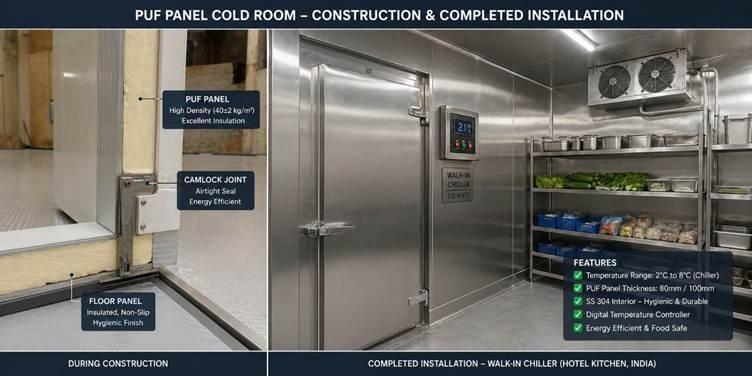
These are the backbone of any serious kitchen. A walk-in cooler typically operates between 2 degrees Celsius and 8 degrees Celsius and is used for bulk storage of fresh produce, dairy, meats, and prepped ingredients. A walk-in freezer operates at minus 18 degrees Celsius or below and holds frozen stock, ice cream, seafood, and long-term inventory.
In hotel kitchens, we often recommend separate walk-in units for different food categories, especially where raw meat and ready-to-eat items need to be segregated.
Cross-contamination between raw and cooked food zones is one of the most common FSSAI compliance gaps we come across during kitchen audits. Having dedicated cold rooms for each category makes this a non-issue.
Walk-in cold rooms in India are typically custom-fabricated using PUF (polyurethane foam) insulated panels, with thickness ranging from 60mm to 100mm depending on the ambient temperature of the kitchen and the target internal temperature. Stainless steel interiors are standard for food-grade applications.
Reach-in Chillers and Freezers
Reach-in units are upright refrigerators or freezers with one to three doors, placed at specific stations within the kitchen. They give chefs direct access to frequently used ingredients without having to walk to a cold room. In a busy line kitchen, the time saved is not trivial.
We usually position reach-in chillers near prep areas and cooking lines. Stainless steel exterior models are preferred in professional kitchens because of durability and ease of cleaning. Brands like Williams, Foster, Gram, and Blue Star are commonly specified in hotel projects, though the right choice depends on the kitchen’s power supply, workflow, and budget.
Under-Counter Chillers
These are exactly what the name suggests. Compact refrigeration units that fit underneath prep counters, typically 600mm to 900mm in height. They are workhorses in high-activity stations like garde manger, pastry, and sandwich stations. A chef should be able to reach down and pull what they need without breaking their workflow.
Under-counter chillers come in drawer configurations, door configurations, and a hybrid of both. For hotel kitchens with custom stainless steel fabrication, we often integrate these units
into the counter itself so the entire prep zone feels seamless. That kind of integration is something we handle in-house at Jacio Indicius, combining our stainless steel fabrication work with equipment placement.
Saladette and Sandwich Prep Units
These are under-counter refrigerators with a refrigerated top rail for ingredient pans, commonly called a saladette or pizza prep table. They keep ingredients at safe temperatures while giving the chef immediate access. Very common in continental kitchens, salad stations, and fast-paced banquet prep areas.
Display Freezers and Display Chillers
In restaurants with open kitchens, buffet setups, or retail-facing food counters, display refrigeration becomes both a functional and presentation element. Glass-door display freezers and visi coolers allow guests to see the product while keeping it at the right temperature. Cake display chillers, open multideck chillers, and back-bar chillers all fall under this category.
For a high-end property, the aesthetic matters. We have seen hotels invest significantly in the right display units for their lobby cafes and patisseries because presentation is part of the product. The refrigeration has to hold temperature reliably, but it also has to look right.
Blast Chillers
Blast chillers are often overlooked in kitchen planning, but they are important for HACCP compliance. They rapidly cool cooked food from above 65 degrees Celsius to below 3 degrees Celsius in a short window, reducing bacterial growth risk during the cooling cycle. In large hotel operations with banquet kitchens or cook-chill production, a blast chiller is close to non-negotiable.

What Is the Difference Between a Walk-in Cooler and a Walk-in Freezer?
The short answer is temperature range and intended use, but the practical differences go further than that.
A walk-in cooler runs between 2 and 8 degrees Celsius. It is designed for products that need to stay cold but not frozen, such as fresh vegetables, dairy products, cut meats, prepped sauces, and beverages. A walk-in freezer operates at minus 18 degrees Celsius or below and is used for frozen products like ice cream, frozen seafood, meat that is being stored long-term, and frozen desserts.
The structural difference matters too. Freezer panels are thicker (typically 100mm or more) compared to cooler panels (60mm to 80mm) because they need to hold a much larger temperature differential against the ambient. Freezer doors also have heater elements built into the door frame to prevent ice buildup and seal failure. All of this makes a walk-in freezer more expensive to fabricate, install, and run than a cooler of the same size.
One thing we commonly recommend for medium to large hotel kitchens is a combination unit, where a cooler and freezer share a wall. This saves on refrigeration plant costs and reduces the overall footprint in kitchens where space is constrained. But the design has to be done carefully because the heat load from the freezer side can affect cooler performance if not properly accounted for.
For a detailed look at how kitchen layout choices like this affect operational efficiency, I covered this in more depth in our post on how equipment layout impacts kitchen efficiency. It is worth reading if you are in the planning stage.
How Do I Calculate the Refrigeration Capacity My Restaurant Needs?
This is one of the more common questions we get, and the honest answer is that there is no single formula that works for everyone. Capacity depends on the type of operation, the menu, the number of covers, receiving frequency, and how much buffer stock the kitchen typically carries.
That said, here is a practical framework we use during kitchen planning consultations.
For a restaurant serving 100 to 150 covers per day with two to three receiving days per week, a single walk-in cooler in the range of 8 to 12 cubic meters is usually a reasonable starting point for fresh produce and dairy. If you are also managing a separate meat and seafood programme, add a second compartment or a separate cooler.
For hotels with multiple F&B outlets, banquet facilities, or in-room dining, the calculation gets more complicated. We typically model refrigeration requirements based on peak stock weight (usually 2 to 3 days of inventory at peak occupancy), the number of separate temperature zones needed, and the receiving dock layout.
A few other factors that are easy to underestimate:
- Heat load from adjacent cooking equipment. If your cold room shares a wall with a hot kitchen, the refrigeration plant has to work harder. Proper insulation and spatial planning matter.
- Door opening frequency. In a high-traffic kitchen, a walk-in that is accessed 30 to 40 times a shift loses cold air constantly. Strip curtains and double-door vestibule designs help.
- Ambient temperature in India. Unlike European kitchens where base ambient temperature might be 20 degrees Celsius, in India, especially in cities like Chennai, Mumbai, or Ahmedabad, kitchens can reach 35 to 40 degrees Celsius in summer. This directly affects compressor sizing.
Oversizing is a common mistake people make assuming it is better to have more capacity. But an oversized refrigeration unit short-cycles, meaning it turns on and off too frequently without completing a proper cooling cycle. This increases wear, consumes more energy over time, and can actually lead to inconsistent temperatures. Get the sizing right, not just big.
What Temperature Should a Commercial Display Chiller Maintain for Food Safety?
The temperature requirement depends on what is being stored. Here is a general reference based on food safety standards applicable in India:
- Fresh dairy products and cut fruits: 1 to 4 degrees Celsius
- Cooked or ready-to-eat foods (display chillers): 1 to 4 degrees Celsius
- Raw meat and seafood: 0 to 3 degrees Celsius
- Display freezers for ice cream: minus 14 to minus 18 degrees Celsius
- Frozen food storage and display: minus 18 degrees Celsius or below
For display chillers specifically, the challenge is maintaining consistent temperature throughout the cabinet despite frequent door openings and ambient heat from the dining area or customer proximity. This is why the coil design, fan placement, and door gasket quality are so important in display units. A cheap display chiller might show 4 degrees on the controller while the actual product temperature near the door is 8 to 10 degrees, which is already in the danger zone for bacterial growth.
In our projects, we specify display units with digital temperature monitoring and alarm systems so that kitchen managers are immediately alerted if temperatures drift. For high-end restaurant and hotel setups, some clients have opted for centralized temperature monitoring across all refrigeration units. It is not standard practice in India yet, but it is becoming more common in premium properties.
What Are the FSSAI Requirements for Refrigeration in Commercial Kitchens in India?
FSSAI (Food Safety and Standards Authority of India) regulations under the Food Safety and Standards (Licensing and Registration of Food Businesses) Regulations, 2011, set out specific requirements for temperature control and cold chain management in food businesses. Here is a practical summary of what matters for restaurant and hotel kitchens.
Under Schedule 4 of the FSSAI regulations, food businesses handling perishable products are required to:
- Maintain adequate refrigeration facilities to store perishable and semi-perishable foods at appropriate temperatures.
- Ensure that raw materials and cooked or ready-to-eat foods are stored separately to prevent cross-contamination.
- Maintain and monitor temperature records, particularly for chilled and frozen storage.
- Ensure that refrigeration equipment is properly maintained and calibrated.
In practice, FSSAI inspectors during audits look for whether the kitchen has sufficient cold storage relative to its scale of operation, whether temperature logs are being maintained, and whether there is visible segregation of raw and cooked items in cold storage.
For hotels and large restaurants, HACCP (Hazard Analysis and Critical Control Points) compliance adds another layer. HACCP plans require defined critical control points for temperature during receiving, storage, preparation, and service. Cold chain documentation becomes part of the audit process.
One thing we pay close attention to in our kitchen design projects is building FSSAI compliance into the layout itself. It is much easier to design a kitchen where segregation happens naturally through the workflow than to try to retrofit compliance later. If you are planning a new kitchen or a significant renovation, this is the right time to get this right. Our post on when to upgrade commercial kitchen equipment goes into more detail on how to assess where your current setup may be falling short.
How Much Does a Commercial Cold Room Cost to Install in India?
This is the question almost every client asks, and the range is wide because a cold room is not an off-the-shelf product. It is a custom installation that varies based on size, insulation spec, refrigeration plant type, finishes, and site conditions.
Here is a rough indicative range for India-based installations as of 2024 to 2025:
- Small walk-in cooler (6 to 8 cubic meters): Approximately Rs. 2.5 lakh to Rs. 4.5 lakh including basic refrigeration plant and installation.
- Medium walk-in cooler (12 to 20 cubic meters): Approximately Rs. 5 lakh to Rs. 9 lakh depending on panel spec and compressor unit.
- Walk-in freezer (same size range): Add 30 to 50 percent to the above due to thicker panels, door heater elements, and higher-capacity refrigeration plant.
- Multi-room cold storage (cooler plus freezer combination or multi-zone systems for hotel kitchens): Rs. 15 lakh to Rs. 40 lakh or more depending on scale and spec.
These are indicative numbers only. The actual cost in any project depends on site access, civil work required (floor drainage, false ceiling height, electrical supply), the refrigeration plant specification, and the brand of components used.
Something clients sometimes underestimate is the civil preparation cost. A cold room installation requires a level floor with appropriate drainage, often a floor drain inside the unit, proper electrical supply with a dedicated circuit, and sometimes ceiling reinforcement to support the panel structure. These costs can add 20 to 40 percent on top of the equipment cost in kitchens that were not originally designed for cold rooms.
In our turnkey projects, we handle everything from CAD layout planning and civil coordination to equipment supply, fabrication, and installation. This means clients get a single point of accountability rather than managing a fragmented chain of vendors. For a project where the cold room needs to integrate with a broader kitchen layout and workflow design, that coordination matters quite a bit. If you are in the early planning phase of a hotel or restaurant build, our post on turnkey kitchen setup planning covers the full project workflow and what to expect at each stage.
A Few Things to Get Right Before You Buy Refrigeration Equipment
I want to flag something that does not get enough attention in equipment-focused buying guides. The refrigeration equipment itself is only part of the picture. How it is integrated into the kitchen workflow, where it is positioned relative to receiving areas and cooking stations, how the refrigeration plant is accessed for maintenance, whether the compressor is
remote-mounted or built-in, all of these affect how well the equipment actually performs over time.
Remote-mounted condensing units, for example, allow the heat generated by the refrigeration plant to be expelled outside the kitchen rather than adding to the already high ambient temperature inside. In Indian kitchens during summer, this is not a small consideration. A kitchen where the condensing unit is inside the same room as the cooking equipment will struggle to maintain cold room temperatures efficiently, and the compressor will have a shorter service life.
Similarly, the placement of strip curtains, automatic door closers, and pressure relief ports on cold rooms all affect the energy efficiency and temperature stability of the unit. These are decisions that should be made during the design phase, not after installation.
We cover preventive maintenance considerations for refrigeration and other kitchen equipment in detail in our post on maintenance tips for commercial kitchen equipment. If you are managing an existing kitchen, that one is worth bookmarking.
Frequently Asked Questions
What is the difference between a visi cooler and a display chiller?
A visi cooler is a glass-door vertical refrigerator typically used for beverages and packaged products, where the primary goal is product visibility and quick access. A display chiller is a broader category that includes open multideck units, cake display chillers, and back-bar chillers, and is designed for food service environments where presentation matters alongside
temperature control. Both operate in the chilled range of 2 to 8 degrees Celsius but serve different merchandising and operational purposes.
Can I use a domestic refrigerator in a commercial kitchen?
Technically you can, but it is not advisable and may not be FSSAI-compliant for licensed food businesses. Domestic refrigerators are not designed for the door-opening frequency, ambient temperature, and load cycling of a commercial kitchen. They fail earlier, are harder to maintain, and do not meet the temperature logging or monitoring standards expected in a commercial food business. The cost difference between a domestic unit and an entry-level commercial reach-in is not as large as people think, especially when you factor in service life and compliance.
How often should commercial refrigeration equipment be serviced in India?
For cold rooms and large reach-in units, a preventive maintenance check every three months is standard for high-use hotel and restaurant kitchens. This includes coil cleaning, condenser cleaning, refrigerant level checks, door seal inspection, and temperature calibration. In Indian conditions, dust and heat accelerate condenser fouling, which is a leading cause of compressor overload and failure. Monthly visual checks by the kitchen team for door seals, condensation, and unusual sounds should also be routine.
What refrigerant is used in commercial refrigeration equipment in India?
Most commercial refrigeration equipment in India currently uses R-404A or R-134a refrigerants, though there is an industry shift toward lower-GWP (global warming potential) alternatives like R-448A, R-449A, and R-290 (propane-based) as India aligns with the Kigali Amendment phase-down schedule. When specifying new equipment, it is worth confirming the refrigerant type and checking whether the brand has a plan for future refrigerant availability, particularly for long-lifecycle assets like cold rooms.
Is energy efficiency important when choosing commercial refrigeration in India?
Very much so. Refrigeration is typically one of the highest energy consumers in a commercial kitchen, running 24 hours a day. A cold room with a poorly specified or oversized compressor, inadequate insulation, or frequent door opening can add significantly to electricity bills over time. Look for BEE-rated equipment where available, consider
remote-mounted condensing units to reduce heat load, and invest in proper insulation panel thickness. For a full discussion on this, our post on energy efficiency in commercial kitchen equipment is a good starting point.
Closing Thoughts
Commercial refrigeration for restaurants and hotels in India is not a category where you want to cut corners, and it is also not one where you need to overspend if you plan carefully. The key is matching equipment type and capacity to how your kitchen actually operates,
integrating it properly into the layout, and building in the maintenance discipline to keep it running well.
At Jacio Indicius, refrigeration planning is part of every turnkey kitchen project we deliver. We look at it from a workflow perspective first, then work backwards to specify the right equipment. If you are planning a new kitchen or revisiting an existing one, we are happy to do an initial consultation to help you think through what you actually need before you start speaking to vendors.
Reach out through jacioindicius.com and we can take it from there.