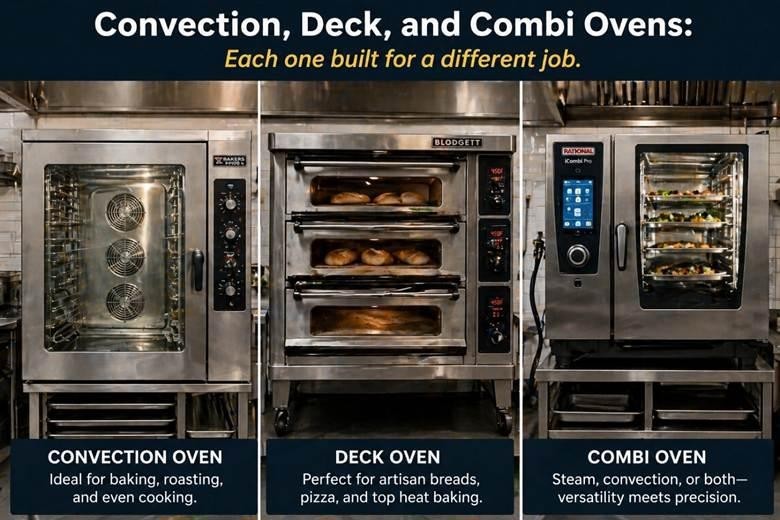
If you are setting up or upgrading a professional kitchen in India and you are confused about which commercial oven to buy, the short answer is this: a convection oven is your everyday workhorse for even baking, a deck oven gives you that authentic crust and spring that artisan bread and pizza needs, and a combi oven does a bit of everything, including steam, dry heat, and humidity control, all in a single unit. That is the quick version. But the real decision is a lot more nuanced, and getting it wrong can cost you lakhs in underused equipment.
I have spent years working with commercial kitchens across India, from five-star hotel banquets in metro cities to standalone artisan bakeries and mid-size QSR chains. The question I get asked most often, perhaps more than any other, is: which oven should I buy? This guide is my attempt to answer that honestly, without the fluff.If you are setting up or upgrading a professional kitchen in India and you are confused about which commercial oven to buy, the short answer is this: a convection oven is your everyday workhorse for even baking, a deck oven gives you that authentic crust and spring that artisan bread and pizza needs, and a combi oven does a bit of everything, including steam, dry heat, and humidity control, all in a single unit. That is the quick version. But the real decision is a lot more nuanced, and getting it wrong can cost you lakhs in underused equipment.
I have spent years working with commercial kitchens across India, from five-star hotel banquets in metro cities to standalone artisan bakeries and mid-size QSR chains. The question I get asked most often, perhaps more than any other, is: which oven should I buy? This guide is my attempt to answer that honestly, without the fluff.
What Types of Commercial Ovens Are Used in Professional Kitchens?
There are three main types you will encounter in Indian commercial kitchens: convection ovens, deck ovens, and combi ovens. Some kitchens also use rotary rack ovens for very high-volume bakery production, but for hotels, restaurants, and standalone bakeries, the first three cover almost every use case.
Convection Oven
A convection oven works by circulating hot air through a motorised fan inside the baking chamber. This continuous airflow removes the cooler air layer that naturally forms around food, which speeds up heat transfer and ensures even browning across trays. It is probably the most common commercial oven type you will find in Indian hotel kitchens and QSR setups. They are relatively affordable, easy to operate, and work well for a wide range of items: bread rolls, pastries, cookies, muffins, gratins, and roasted vegetables. Most commercial convection ovens in India run on either LPG or electricity, and a standard half-size model will fit 4 to 5 GN 1/1 trays.
Deck Oven
A deck oven bakes through two mechanisms: conduction from the stone or steel baking deck below the product, and radiant heat from the walls of the chamber surrounding it. The thermal mass of the stone deck stores and releases heat steadily, which is why deck ovens produce that characteristic open crumb, good oven spring, and the kind of crackly crust you simply cannot replicate in a fan oven. If your hotel bakery or standalone bakery works
heavily with artisan sourdough, baguettes, ciabatta, or even tandoor-style flatbreads, a deck oven is genuinely hard to replace. Most models available in India come in two, three, or four deck configurations, and each deck can be controlled independently for temperature.
Combi Oven
A combi oven, short for combination oven, blends dry convection heat with steam injection and humidity control in a single cavity. You can run it in three basic modes: pure convection (hot air), pure steam, or a combination of both. The combination mode is where it really earns its price tag. With precise humidity control, a combi oven can protect moisture in delicate items like cheesecakes, custards, and laminated pastries, while still achieving even colour and texture. Advanced models like the Rational iCombi Pro or the Unox range come with programmable cooking cycles, core temperature probes, and auto-cleaning systems.
For hotel kitchens that need to handle everything from breakfast pastries to banquet roasts to rethermalisation, a combi oven is probably the single most versatile piece of equipment you can invest in.
What Is the Difference Between a Convection Oven and a Combi Oven?
This is probably the question I get asked the most, and I understand why. Both use fans. Both look similar from the outside. But they are fundamentally different pieces of equipment.
A convection oven only moves hot air. That is its one job, and it does it well. The fan speed and the temperature are your primary controls. A combi oven, on the other hand, can inject steam into the cavity at specific humidity percentages, ranging from about 10% to 100% relative humidity depending on the model. That steam capability changes everything.
Here is a practical example:
If you are baking croissants in a convection oven, the dry heat will give you a good colour and flake. But in a combi oven, you can inject a burst of steam in the first few minutes and then switch to dry heat. The steam delays crust formation, allowing the layers to separate more fully before setting. The result is a noticeably more open, layered structure. Similarly, with roasting a chicken, convection will cook it fine, but combi mode keeps the breast meat juicier while still crisping the skin.
Quick Comparison: Convection vs. Combi vs. Deck Oven
| Feature | Convection Oven | Combi Oven | Deck Oven |
| Heat Method | Forced hot air | Hot air + steam | Conduction + radiant heat |
| Steam Control | No | Yes (10-100% RH) | Manual steam inject only |
| Best For | Cookies, rolls, pastries | Multi-purpose cooking | Artisan bread, pizza |
| Energy Type | Electric / Gas | Electric + water line | Gas / Electric |
| Training Needed | Low | Medium to High | High |
| Price Range (India) | Rs. 80K – 3L | Rs. 3L – 20L+ | Rs. 1.5L – 8L |
Which Commercial Oven Is Best for a Hotel Bakery in India?
Honestly, there is no single right answer here. It depends on what your menu looks like and how your kitchen operates. But I can give you some guidance based on common hotel kitchen setups in India.
For a Full-Service Hotel with a Dedicated Bakery Section
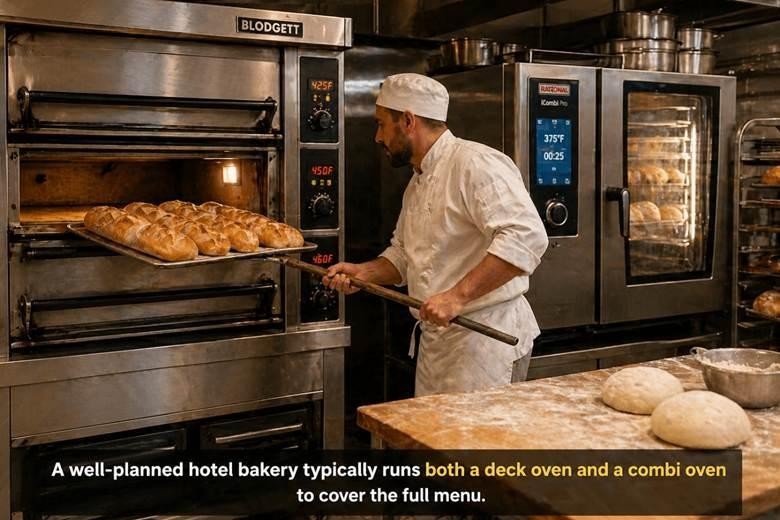
The ideal setup is a combi oven paired with a deck oven. The combi handles your daily breakfast items, bread rolls, croissants, muffins, and morning pastries. It also covers the banquet side: roasts, vegetable dishes, steam-cooked proteins. The deck oven handles your bread program, baguettes, sourdough, focaccia, anything where crust and crumb structure is the point. Having both means your team is never fighting over one oven during a busy breakfast service.
For a Standalone Bakery in India
If your bakery sells mostly bread, the deck oven should be your first investment. A double or triple deck configuration with independent temperature controls per deck gives you the flexibility to bake different products simultaneously. Add a convection oven for your cookies, puffs, khari biscuits, and cakes. If you have the budget and the volume, a combi oven can replace both, but for most small and mid-size bakeries in India, two separate ovens actually gives you more production capacity for the price.
For a Restaurant or QSR
A single combi oven is often enough, particularly if you are not running a dedicated bakery programme. Its ability to roast, steam, retherm, and bake in the same unit makes it highly space-efficient, which matters a lot in the compact kitchens most Indian restaurants are working with.
How Much Energy Does a Commercial Convection Oven Consume?
Energy consumption is one of those things people ask about after buying, and I think that is the wrong approach. You should factor it in before you commit to a model.
A standard single-phase electric commercial convection oven in India typically consumes between 2 kW and 5 kW per hour depending on the size and brand. A half-size model like the Unox XBC or similar will run around 2.5 kW to 3 kW. A full-size, double-fan convection oven can consume 4 kW to 6 kW. Three-phase electric models used in larger operations can push up to 9 kW or more.
Gas-fired convection ovens are a popular choice in India, especially where commercial LPG connections are available, since running costs tend to be lower per hour compared to electricity in many Indian states. That said, electric ovens offer more precise temperature control, which matters for delicate items.
Rough Energy Benchmarks (Electric):
- Half-size convection oven: 2.5 kW to 3.5 kW per hour
- Full-size convection oven: 4 kW to 6 kW per hour
- Combi oven (6-tray): 6 kW to 9 kW per hour
- Combi oven (20-tray): 14 kW to 20 kW per hour
- Deck oven (2 decks, electric): 5 kW to 9 kW per hour
One thing worth noting: newer combi ovens from brands like Rational, Unox, and Angelo Po come with energy-saving modes and intelligent preheating that can reduce actual consumption by 20% to 30% compared to older models. When you are buying for a
high-volume operation, that figure can meaningfully affect your monthly electricity bill.
What Is the Price Range of Commercial Ovens in India?
Prices vary quite a bit depending on brand, capacity, features, and whether you are buying imported or locally manufactured equipment. I will try to give you realistic numbers rather than just broad ranges.
Commercial Convection Ovens
Entry-level convection ovens from Indian manufacturers or budget imports typically start at Rs. 60,000 to Rs. 1,20,000 for a 4 to 5 tray half-size model. Mid-range models from established brands like Unox, Giorik, or local players like Hobart and Baron can run from Rs.
1.5 lakh to Rs. 3 lakh. High-end full-size convection ovens with reversible fans, humidity injection, and advanced controls can reach Rs. 4 lakh to Rs. 6 lakh.
Deck Ovens
A double-deck stone oven from a mid-range brand will typically cost between Rs. 1.5 lakh and Rs. 4 lakh in India. Triple-deck configurations used in high-volume bakeries can go from Rs. 3.5 lakh to Rs. 8 lakh. European brands like Bongard, Sveba, or Moretti Forni are available through importers and command a premium, often Rs. 6 lakh and above for a
two-deck professional model.
Combi Ovens
This is where prices jump significantly. Entry-level combi ovens, usually 6-tray models from regional manufacturers, start at around Rs. 3 lakh. Mid-range European combi ovens like the Unox CHEFTOP MIND.Maps or the Electrolux Air-O-Steam range from Rs. 5 lakh to Rs. 10 lakh. The top-tier Rational iCombi Pro, widely considered the industry benchmark, starts at Rs. 12 lakh and can go up to Rs. 22 lakh or more for a 20-tray full-size model. The price is real. So is the difference in consistency, food yield, and long-term operating cost.
A word of caution: I have seen kitchens buy the cheapest combi oven available and spend more on repairs in the first two years than they would have on a better model. Steam systems require consistent water quality and regular descaling. A cheap unit with poor build quality can become a maintenance headache quickly, especially in Indian conditions where water hardness varies significantly by region.
How Do I Maintain a Commercial Oven to Extend Its Lifespan?
Maintenance is probably the most underrated part of owning commercial kitchen equipment. A well-maintained commercial oven can run productively for 10 to 15 years. A neglected one will start giving you problems in two or three. Here is what I tell every kitchen I work with.
Daily Maintenance
- Wipe down the interior cavity and door gaskets after every shift to prevent grease buildup. Grease carbonises over time and becomes very difficult to remove.
- Check the door seals for cracks or deformation. A failing gasket means heat loss and uneven baking temperatures.
- For combi ovens, run the self-cleaning program at the end of each day if the unit has one. If not, manually clean the steam generator area at least three times a week.
- Remove and clean tray runners and wire racks to prevent cross-contamination and corrosion.
Weekly and Monthly Maintenance
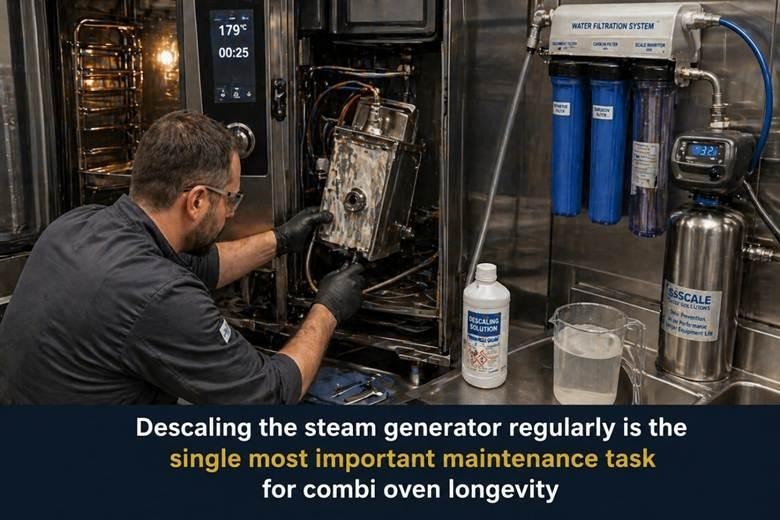
- Descale the steam generator and water lines in combi ovens at least once a week in areas with hard water. In cities like Delhi or Jaipur where water hardness is high, you may need to descale more frequently. Limescale buildup is the number one reason combi ovens fail prematurely.
- Check the fan motor and fan blades for grease accumulation. A clogged fan reduces airflow efficiency and causes temperature inconsistency.
- Inspect the heating elements in electric ovens for visible damage or discolouration. In gas models, check burner flames for even distribution.
- Calibrate the thermostat against a known probe thermometer every month. Many older ovens drift in calibration over time and you would not know unless you check.
Annual Servicing
Get a professional technician to inspect door hinges, thermostat accuracy, heating element condition, gas valve integrity (for gas models), and the control board at least once a year. For combi ovens, the water inlet filter, drain filter, and steam injection nozzles should all be cleaned and inspected annually. This is also a good time to check for software updates on models with digital control systems.
One thing that often gets skipped in Indian kitchens is water filtration. Running a combi oven on unfiltered tap water is genuinely one of the most damaging things you can do to the equipment. A basic inline water softener or filtration unit, which costs relatively little, can double the effective lifespan of your steam system. At Jacio Indicius, we always recommend discussing water quality at the time of equipment selection, because the right filtration setup can save you significant repair costs down the line.
A Few Things I Think People Get Wrong When Buying Commercial Ovens in India
This is perhaps not the section you expected, but I think it is important.
Buying by brand name alone
Rational is excellent. So is Unox. But buying a premium combi oven when your actual need is a reliable convection oven for a 30-cover restaurant is an expensive mistake. The brand should follow the function, not the other way around.
Underestimating installation requirements
A combi oven needs a dedicated water supply line, a floor drain, appropriate electrical load capacity (sometimes three-phase), and proper ventilation clearance. Many kitchen renovation projects in India run into delays and added costs because these requirements were not accounted for in the initial layout. This is exactly the kind of detail covered in a proper kitchen commissioning process, and it is something Jacio Indicius takes seriously with every project.
Not thinking about after-sales service availability
This one genuinely matters. A combi oven that breaks down during a wedding banquet and has no local service support available for two weeks is a real problem. Before buying any commercial oven in India, check whether the brand has authorised service centres in your
city or region, what the average response time is, and whether spare parts are locally stocked. Some imported brands are excellent equipment but have very limited service reach outside the four or five major metros.
Related Reading from Jacio Indicius
If you found this useful, you might also want to read the following:
- When Should You Upgrade Your Commercial Kitchen Equipment?
- Why Equipment Commissioning Is Critical in Commercial Kitchens
- Maintenance Tips for Commercial Kitchen Equipment
FAQs: Commercial Ovens in India
Can a combi oven completely replace a convection oven in a hotel kitchen?
Technically yes. A combi oven in dry convection mode functions like a high-end convection oven. But in practice, most high-volume hotel kitchens keep both, because a separate convection oven increases total production capacity and gives you a backup when one unit needs servicing.
Is a deck oven better than a convection oven for baking bread?
For artisan bread styles that rely on oven spring, open crumb structure, and a thick crackly crust, yes, a deck oven is better. For standard bread rolls, sandwich bread, or soft buns, a convection oven works perfectly well and is faster for high volume.
What is the best commercial oven brand available in India?
For combi ovens, Rational and Unox are the most widely respected brands in the Indian market. For deck ovens, Moretti Forni, WP Bakery Group, and certain local manufacturers offer reliable options. For convection ovens, Unox, Giorik, and Electrolux Professional are strong choices. The best brand for your kitchen depends on your budget, menu, and service support requirements in your location.
How often should a commercial combi oven be descaled in India?
In cities with hard water, such as most of North India, descaling once every five to seven days of heavy use is recommended. In areas with softer water, once every two weeks may suffice. Always follow the manufacturer’s recommendation and monitor the frequency based on your water quality report.
What is the average lifespan of a commercial oven in India?
A well-maintained commercial convection oven typically lasts 10 to 15 years. Deck ovens, because of their simpler mechanical construction, can last even longer, sometimes 15 to 20 years, provided the heating elements and thermostats are serviced regularly. Combi ovens have more components and electronics and typically run reliably for 8 to 12 years with proper maintenance.
Final Thoughts
Choosing the right commercial oven is not about picking the most expensive model or the most well-known brand. It is about understanding your menu, your production volume, your kitchen space, your team’s skill level, and what your local service infrastructure can support. A Rs. 4 lakh deck oven that perfectly fits your bakery’s needs will serve you far better than a Rs. 15 lakh combi oven that your team does not know how to use.
At Jacio Indicius, we work with hotels, restaurants, and bakeries across India to help them select, specify, and set up commercial kitchen equipment that actually fits how they cook. If you are in the process of setting up a new kitchen or upgrading your existing oven setup, we are happy to help you think it through. No pressure, just honest advice.
Visit jacioindicius.com to explore our range of commercial ovens or get in touch with our team.