Table of Contents
• Why Handover Is More Than Just Completion
• What Is a Structured Kitchen Handover Process?
• Technical Validation Before Handover
• Utility and Load Verification
• Compliance and Documentation Review
• Operational Readiness Testing
• How I Structure a Proper Handover Process
• Frequently Asked Questions
• Final Thoughts and Specialist Takeaways
Why Handover Is More Than Just Completion
The kitchen might appear ready once installation is complete. That is just the halfway mark, based on my experience.
Turning on equipment is not the goal of handover. The goal is to verify that the entire kitchen operates reliably under actual service conditions. Hidden problems will come to light during peak operations if this step is hurried.
I’ve seen kitchens where everything looked fine on the surface, but when cooking loads were applied simultaneously, the ventilation struggled, and the circuits tripped. With structured validation, these problems can be found sooner.
Completion indicates that the installation is finished. The system is proven when it is handed off.

What Is a Structured Kitchen Handover Process?
A commercial kitchen handover checklist is a formal validation process that is completed before the facility is made available for use.
This procedure validates:
- When operating under load, the equipment functions.
- Utilities allow for concurrent use.
- Proper ventilation controls heat and smoke.
- Safety systems react as planned.
- The documentation is accurate and comprehensive.
It links operational readiness with installation work. Without it, you depend on conjecture rather than confirmation.
Technical Validation Before Handover
Every significant category of equipment needs to undergo both individual and group testing.
This comprises:
Kitchenware
Testing ranges, fryers, kettles, and ovens while they are in continuous use
Cooling
Checking recovery cycles and temperature stability
Systems for washing dishes
Verifying drainage flow, heating efficiency, and water pressure
I don’t use inactive testing. Realistic service circumstances are necessary for equipment to function. This exposes alignment problems, overheating, and electrical instability that are invisible to the naked eye.
Utility and Load Verification
A crucial checkpoint in any commercial kitchen project is utility validation.
Before signing off, I certify:
- The authorised electrical load corresponds to the connected demand.
- Distribution boards are appropriately balanced and labelled.
- The gas pressure stays constant at simultaneous peak operation.
- Discharge is managed via drainage systems without overflow.
Improper load approval in India may lead to problems with the power authority’s compliance. LPG systems must follow PESO piping and storage standards.
Disruptions after opening are avoided by verifying these components at handover.
Compliance and Documentation Review
Clear documentation must be part of the handover process.
Usually, this entails reviewing:
- Infrastructure alignment according to FSSAI Schedule 4
- Verification of the fire department’s NOC
- Manuals and guarantees for equipment
- As-built service blueprints
- Certifications for safety
Future issues during audits or maintenance are caused by incomplete documentation. Before signing off, I make sure all the paperwork is in order and checked.
During this phase, operational continuity is ensured by adhering to all regulatory procedures.
Operational Readiness Testing
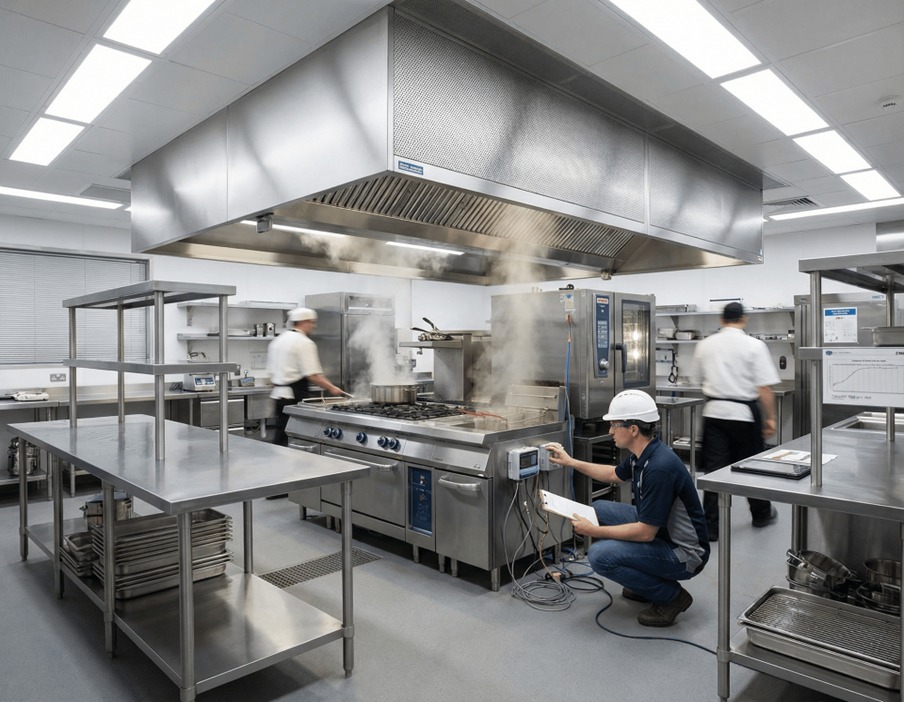
Testing for operational readiness verifies that the kitchen operates as a single system.
In this stage, I mimic service circumstances by:
- Using many culinary gadgets at once
- Tracking the performance of the exhaust under heat load
- Testing fire suppression triggers and emergency shut-offs
- Monitoring access clearances and process movement
This stage finds temperature increases, airflow imbalances, or workflow bottlenecks that are not visible during isolated equipment testing.
In addition to confirming installation completion, handover should verify operating stability.
How I Structure a Proper Handover Process
I view handover as a specific accomplishment.
My methodical procedure consists of:
- Walkthrough of the pre-handover inspection
- Validation of utility and safety
- Testing the performance of equipment while it is under load
- Verification of paperwork and compliance
- Technical orientation and operator briefing
At this point, the distinction between turnkey kitchen execution and fragmented execution frequently becomes evident. Validation runs smoothly and predictably when coordination is properly organised.
A well-organised checklist for commercial kitchen handovers eliminates uncertainty and guarantees operational trust right away.
Frequently Asked Questions
Does the law require a handover checklist?
Although it may not always be required, it is essential for operations.
How much time does it take to validate?
Several days may pass, depending on the project’s size.
Is it possible to open without complete validation?
Although you run the danger of finding problems while in service, it can.
Who ought to be in charge of the handover stage?
Technical oversight should collaborate with the execution partner.
Does staff training fall under this category?
The core goal is still system validation, even with training added.
Final Thoughts and Specialist Takeaways
A structured commercial kitchen handover checklist protects you from avoidable failures after installation.
Installation verifies that the required parts are present. Under operational stress, handover verifies that those parts work in unison.
You may lower risk, preserve alignment with compliance, and open with confidence if you approach this phase as system validation rather than paperwork.