Table of Content
- Why Kitchen Layout Is the Foundation of Efficient Operations?
- What Are Commercial Kitchen Layout Basics?
- Core Principles Behind Efficient Commercial Kitchen Layouts
- Common Commercial Kitchen Layout Types and Their Use Cases
- Essential Workflow Zones in Professional Kitchen Layout Design
- How Do Commercial Kitchen Layouts Impact Safety, Productivity, and Compliance?
- How to Choose the Right Commercial Kitchen Layout for Your Operation?
- Frequently Asked Questions
- Final Thoughts and Planning Takeaways
Why Kitchen Layout Is the Foundation of Efficient Operations?
Commercial kitchen layout planning is the first step I always take when consulting on a professional kitchen project. I do this because long-term operational costs, worker mobility, workflow, and safety are all determined by commercial kitchen design.
A poorly designed layout frequently results in longer preparation times, more expensive labor, more frequent bottlenecks, and a larger chance of cross-contamination. On the other hand, well-thought-out restaurant kitchen layouts facilitate more efficient operations by guaranteeing that food flows logically from receiving to preparation to serving without needless detours. This type of commercial kitchen workflow plan minimizes staff congestion, delays, and unnecessary food rehandling. It’s crucial to realize that layout involves more than just a spatial choice before delving into particular layouts. It is an operational strategy that has a direct impact on staff efficiency, productivity, and compliance readiness.
What Are Commercial Kitchen Layout Basics?
When I talk about commercial kitchen layout basics, I’m referring to the fundamental ideas that professional kitchen layouts employ to arrange workstations, zones, and equipment in a way that promotes productivity, safety, and hygiene.
Fundamentally, this comprises:
A commercial kitchen’s logical workflow evolution
- Staff mobility that is both safe and effective
- Equipment and storage locations that are functional
- conformity to sanitary, safety, and health regulations
Practically speaking, expert commercial kitchen design guarantees that every step of the process, from receiving ingredients to final plating, follows a precise and consistent route. Because it lowers operational friction and increases uniformity, this method is frequently used in foodservice planning.
Core Principles Behind Efficient Commercial Kitchen Layouts
When assessing or creating commercial kitchen layouts, I base my decisions on a number of concepts.
Workflow advancement that makes sense
From receiving and storing to preparing, cooking, plating, and cleaning, an effective kitchen adheres to a defined process. This lowers the risk of contamination and minimizes needless movement.
Keeping clean and unclean places apart
For hygienic reasons and to ensure compliance, clean areas like plating and fresh preparation must be kept apart from dishwashing and waste areas.
Ergonomic mobility
The layout of stations should allow employees to work without frequently crossing paths. Ergonomic designs improve service speed and lessen fatigue when compared to poorly designed layouts.
Efficiency in space without sacrificing
When equipment is positioned purposefully and zones are clearly defined, even small kitchens can function successfully.
Integration of ventilation and safety
To properly control heat, smoke, and grease, ventilation systems must be constructed alongside cooking equipment, regardless of the type of layout. These guidelines serve as the foundation for trustworthy commercial kitchen workflow layout planning and are applicable to all sorts of professional kitchens.
Common Commercial Kitchen Layout Types and Their Use Cases
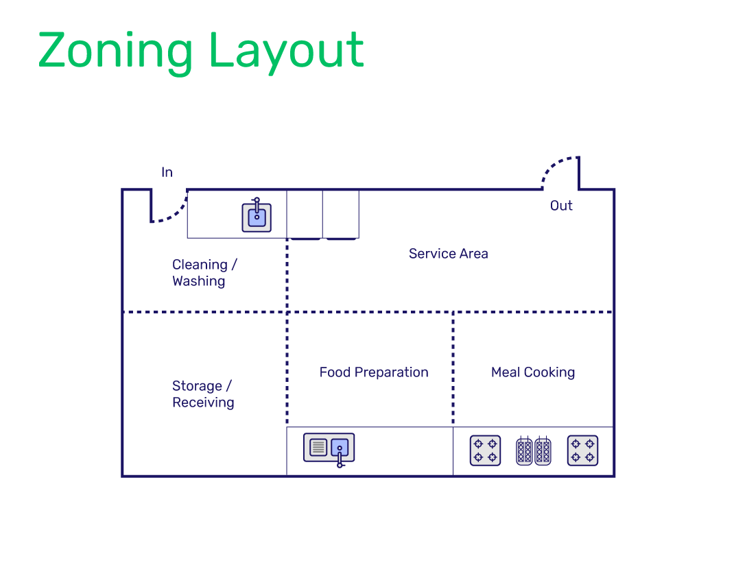
Different commercial kitchen layout types require different layout approaches. As illustrated in the layout diagrams above, each layout serves a distinct operational purpose.
Assembly line layout
Stations are arranged in a straight line from preparation to cooking to plating. It is frequently utilized in high-volume delivery and quick service operations. Assembly lines put speed and repetition ahead of flexibility, in contrast to zoned design. Because of this, complex menus requiring frequent station crossover are less suited for assembly line setups.
Zone-style layout
The kitchen is divided into certain functional areas, such as prep, cooking, plating, and cleaning, according to zone layouts. The food flow in a zonal kitchen system is depicted in the diagram below. This strategy is effective for operations that handle large numbers of dine-in customers and multi-cuisine restaurants. This arrangement is still among the best restaurant kitchen layouts for full-service dining.
Island layout
The main cooking appliances are positioned in the middle of island kitchens, surrounded by prep and cleaning areas. Strong hygiene discipline is necessary, but this design enhances oversight and communication.
Galley layout
When there is a shortage of space, galley layouts are frequently utilized to arrange stations along parallel walls. Galley kitchens are more efficient in small spaces than island layouts, but they require careful workflow planning. Despite space limitations, galley kitchens can still be extremely effective commercial kitchen layouts when properly designed.
Open kitchen layout
The kitchen and client spaces are visually connected by open design. In contrast to closed restaurant kitchen designs, open kitchens improve openness and brand trust while requiring stricter hygiene regulations and more robust ventilation management.
Each of these patterns is chosen based on the nature of food service, volume, and available square footage.
Essential Workflow Zones in Professional Kitchen Layout Design
According to my project experience, well-designed zones are a constant feature of successful professional kitchens.
Receiving and storing
Handling time and congestion are decreased when storage is located close to receiving.
Area of preparation
Washing, chopping, marinating, and portioning are all supported in this area. Both speed and food safety are enhanced by being close to cold storage.
Line of cooking
Heat-based preparation takes place in the center of the kitchen. It is thought to be best practice to group cooking equipment beneath a shared ventilation canopy.
Pass area and plating
This is the area where completed dishes are put together and taken out of the kitchen. Placing things strategically minimizes needless moving.
Cleaning and dishwashing area
To avoid cross-contamination, this space should be kept physically apart from the food preparation area. These areas work together to create the foundation of effective commercial kitchen layouts.
How Do Commercial Kitchen Layouts Impact Safety, Productivity, and Compliance?
Operational results are directly impacted by a well-planned layout.
Enhanced safety of food
The risk of contamination is decreased, and inspection needs are supported when raw and cooked zones are physically separated.
Reduced labor expenses
Reduced bottlenecks and more efficient circulation aid in managing staffing requirements.
Increased adherence to regulations
Handwash stations, restrooms, and traffic lanes should be positioned correctly to guarantee that compliance is incorporated into the design rather than added after the fact.
Increased employee morale
Logical arrangements make workplaces safer and less stressful during busy service times. These advantages highlight the importance of layout planning in professional kitchen design.
How to Choose the Right Commercial Kitchen Layout for Your Operation?
I advise choosing a commercial kitchen layout that is directly in line with your business model:
- Zoned or island layouts are advantageous for organizations with high dine-in volumes.
- Assembly or galley layouts work well for delivery-focused models.
- Compact galley-style planning is necessary due to limited floor area.
- Open kitchen designs are beneficial for brands that prioritize visibility.
- Layouts for complex menus must minimize station-to-station travel.
This approach maintains operational soundness and objectivity in decision-making.
Before choosing a layout, start with your menu and plan out each dish’s workflow.
Indeed. Effective small commercial kitchen layouts are made possible by clear zoning and vertical storage.
Cross-contamination is less likely when raw and cooked regions are kept apart.
While assembly plans are ideal for repeated, high-volume output, zone layouts are better suited for complicated menus.
Of course. To prevent congestion, equipment placement must be in line with workflow.
Final Thoughts and Planning Takeaways
In commercial kitchen planning, the fundamentals of commercial kitchen layout are not discretionary. They serve as the cornerstone of operations that are scalable, effective, and safe. When designing a kitchen, begin by establishing your workflow, choosing a layout that complements your service model, and including compliance needs as soon as possible. Correct layout planning increases efficiency, lowers hazards, and makes long-term operational stability possible.