Table of Contents
- Why Kitchen Design Determines Operational Success
- What Are Commercial Kitchen Design Principles?
- Workflow First: Designing for Movement and Efficiency
- Zoning and Functional Separation in Kitchen Design
- Equipment Placement and Spatial Planning
- Ventilation, Heat, and Environmental Control
- Hygiene, Safety, and Compliance by Design
- Scalability and Future-Ready Kitchen Planning
- How to Apply Design Principles to Your Kitchen
- Frequently Asked Questions
- Final Thoughts and Design Takeaways
Why Kitchen Design Determines Operational Success
I rarely assess professional kitchens by equipment brands or finishes. I always start with design rationale.
A well-designed kitchen promotes consistency, speed, safety, and hygiene. A poorly designed one forces employees to deal with constraints daily. This eventually results in increased labor expenses, frequent malfunctions, unsuccessful inspections, and employee exhaustion.
A kitchen’s appearance is not what design is all about. It has to do with how it functions under duress. Because of this, it is crucial to understand the principles of commercial kitchen design before making any investments in infrastructure, equipment, or design.
What Are Commercial Kitchen Design Principles?
Commercial kitchen design principles are core rules for organizing people, equipment, and space to optimize food production.
These guidelines concentrate on:
- Logical staff and food movement
- Clearly defined roles
- Hygienic and safe working conditions
- Adherence to food safety, ventilation, and fire regulations
- Long-term adaptability in operations
Experience has shown that kitchens that adhere to these guidelines throughout the planning phase run more smoothly and need fewer adjustments down the road.
Workflow First: Designing for Movement and Efficiency
Workflow is the first step in any successful kitchen design.
The process by which ingredients are received, stored, prepared, cooked, plated, and cleaned is called workflow. This flow should be supported by design, with no needless backtracking or path crossings.
Employees lose time moving rather than producing when workflow is neglected. Productivity automatically rises when workflow is respected.
Efficient kitchens reduce traffic during peak hours by following a clear, linear, or zoned movement pattern, as seen in the workflow architecture above.
Whether you are constructing a restaurant, cloud kitchen, or production facility, this idea holds true for all formats.
Zoning and Functional Separation in Kitchen Design
Zoning is a pivotal design decision.
A professional kitchen should be separated into several areas, like:
- Receiving and storing
- Getting Ready
- Preparing food
- Dispatch or plating
- Waste and dishwashing
Every zone has a distinct function and shouldn’t impede any other zone. For instance, dishwashing and garbage transportation should never coincide with areas designated for clean food preparation.
The accompanying diagram illustrates how zoned kitchens make inspections easier and decrease cross-contamination. In my experience, zoning frequently makes the difference between a kitchen that consistently fails inspections and one that passes them with ease.
Equipment Placement and Spatial Planning
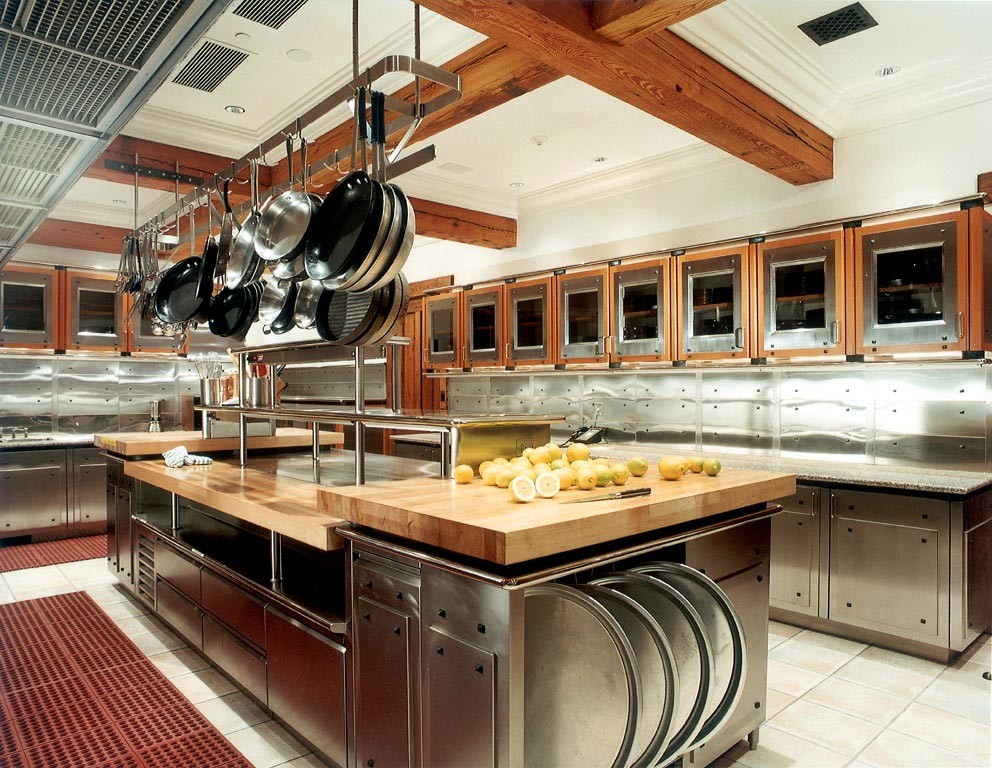
Equipment should never be arranged haphazardly or only according to available space.
Effective spatial planning takes into account:
- Regularity of usage
- Heat production
- Access to cleaning
- Clearance for maintenance
- Ergonomics for employees
Shared ventilation systems should be used to group cooking equipment. Equipment for preparation should be near storage. Prep and cooking areas should be supported by refrigeration without impeding movement.
Purposeful equipment layouts improve service flow and reduce failures compared to cluttered arrangements.
Ventilation, Heat, and Environmental Control
Environmental control is not an afterthought but rather a fundamental design principle.
Commercial kitchens produce a lot of steam, smoke, heat, and grease. Kitchens become dangerous, uncomfortable, and non-compliant without adequate ventilation planning.
Design needs to incorporate:
- Kitchen hood systems that are the right size
- Sufficient airflow from the exhaust
- Air balance for makeup
- Controlling the heat near cooking lines
Well-designed exhaust systems preserve equipment, minimize fire risk, and ensure staff comfort, as shown in the ventilation plan above.
Hygiene, Safety, and Compliance by Design
If the design is incorrect, hygiene and safety cannot be rectified operationally.
The following must be supported by design principles:
- Surfaces that are easy to clean and non-porous
- Proper location of the handwash station
- Areas for raw and prepared food should be clearly separated.
- Safe movement routes and aisle widths
- Emergency exits and fire safety access
Kitchens built for compliance face fewer disruptions. Purposeful design upholds hygiene better than later adjustments.
Scalability and Future-Ready Kitchen Planning
Scalability is a design principle that is frequently disregarded.
A lot of kitchens are built with the current volume in mind. Layouts become stretched and ineffective as demand rises.
Future-ready design takes into account:
- Room for more equipment
- Layouts that are modular
- Expandable utility capacity
- Adaptability for menu evolution
I’ve found that kitchens that plan for expansion prevent expensive redesigns and future downtime.
How to Apply Design Principles to Your Kitchen
I suggest beginning with your operating model when converting commercial kitchen design principles into practical choices.
- Zoned or island-style layouts are advantageous for large dine-in volumes.
- Linear, dispatch-oriented flow is more effective in delivery-focused kitchens.
- Shared prep and separate finishing zones are necessary for multi-brand operations.
- Production kitchens require layouts that are process-driven and batch-oriented.
- Precise spatial planning is necessary for venues with limited space.
This method ensures design supports, not limits, operations.
Frequently Asked Questions
Do all types of kitchens follow the same design principles?
The fundamental ideas are the same, but how they are used differs depending on the size and format of the kitchen.
Can a bad design be corrected later?
Redesigns are frequently costly and disruptive, although some problems can be fixed.
When should a kitchen’s design be finalized?
Prior to the start of construction or equipment acquisition. Everything that comes after is shaped by design choices.
Does effective design lower operating expenses?
Indeed. Labor hours, energy waste, and maintenance problems are all decreased with efficient layouts.
Should maintenance and post-purchase assistance be taken into account in design?
Of course. One of the most important design factors is easy access for maintenance and cleaning.
Final Thoughts and Design Takeaways
Principles of commercial kitchen design are not theoretical ideas. They serve as operational protections.
Good design delivers operational excellence, confident teams, reliable compliance, and scalable growth. When neglected, every service becomes a workaround. Prioritize principles over equipment when designing or renovating. Smart design brings long-term gains in maintenance, safety, and efficiency.