Table of Contents
- Why Space Planning Comes Before Everything Else
- What Is Commercial Kitchen Space Planning?
- Understanding Space Requirements by Kitchen Function
- Allocating Space for Workflow and Movement
- Equipment Footprint and Clearance Planning
- Storage, Utilities, and Service Space Considerations
- Planning for Scalability and Future Expansion
- How to Approach Early-Stage Space Planning
- Frequently Asked Questions
- Final Thoughts and Planning Takeaways
Why Space Planning Comes Before Everything Else
Equipment brands and finishes are never my first points of discussion when I join a kitchen remodel. The priority is always space.
Space shapes mobility, equipment safety, and kitchen scalability. Early decisions about space are the hardest and priciest to change later.
Kitchens prioritizing early space planning run smoothly, have fewer layout compromises, and expand more easily. Early planning creates the most value.
What Is Commercial Kitchen Space Planning?
When I talk about commercial kitchen space planning, I mean the strategic distribution of available space to support food production, safety, hygiene, and workflow.
Important questions are addressed by this planning process:
- The amount of space needed for each function
- How food and employees will travel between zones
- Where equipment ought to be positioned to avoid congestion
- How to safely access utilities and services
Space planning does not mean maximizing equipment density. It balances maintainability, safety, and productivity.
Understanding Space Requirements by Kitchen Function
Each functional zone in a professional kitchen has specific space requirements. For example, the storage area must allow for the quick and hygienic separation of dry and refrigerated goods upon delivery, while the dishwashing section requires sufficient space to accommodate sanitizing equipment and enable the efficient movement of soiled and clean items. Understanding these requirements is key to ensuring efficient operations in every area, from delivery to dishwashing.
Receiving and storage
For unloading, inspecting, and separating dry, chilled, and frozen commodities, sufficient space is required. Hygienic and inventory problems arise rapidly in crowded storage facilities.
Preparation Area
Prep zones should be adjacent to storage, offer ample counter depth, and permit smooth movement. Undersized prep areas hamper productivity and increase cross-traffic.
Cooking Zone
Cooking lines require space for equipment, unobstructed movement, ventilation, and heat dispersal. Accident risk increases when heated equipment is closely spaced.
Plating or dispatch
This area must allow quick handoff without blocking prep or cook lines, especially during peak service.
Waste and dishwashing
Zones must remain separated and feature clear, unobstructed entry and exit points to prevent the spread of contaminants and avoid workflow bottlenecks.
Allocating Space for Workflow and Movement
One of the most common errors I observe is planning space based only on total square footage, rather than conducting a detailed analysis of how staff, food, and equipment will move throughout the kitchen during typical operations.
Effective kitchens distribute space according to:
- Frequency of tasks
- Number of employees at peak service
- Food flows in both directions, from raw to finished.
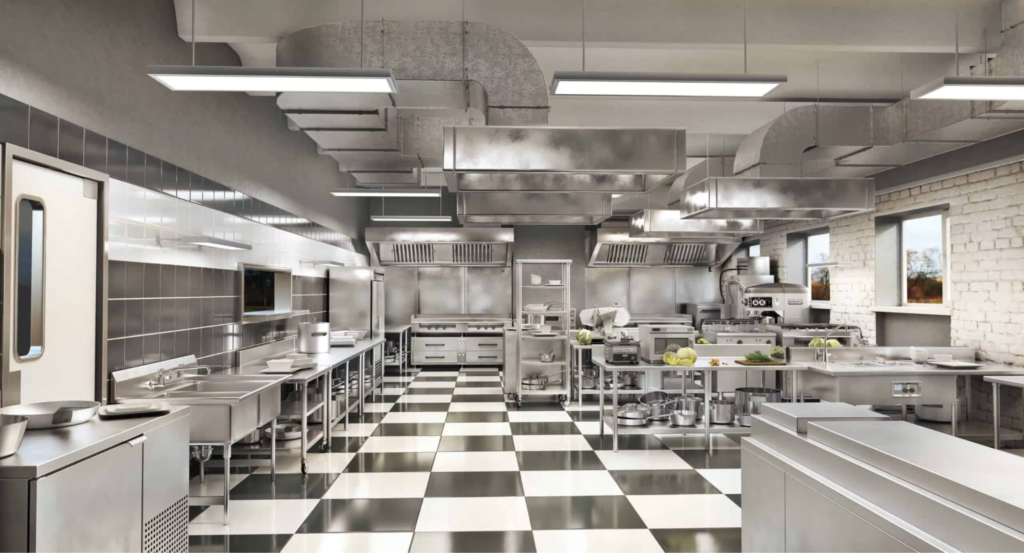
Well-zoned kitchens cut down retracing and crossing paths, as demonstrated in the workflow zoning above. Kitchens with defined corridors perform better under pressure than crowded layouts.
This is a fundamental reason why operations, not presumptions, should guide the planning of commercial kitchen space.
Equipment Footprint and Clearance Planning
Equipment choice directly affects space needs.
Each piece of gear has:
- An actual footprint
- Operating clearance is necessary (extra space around equipment so doors or parts can move freely and staff can work safely).
- Needs for maintenance access
Planning needs to take into consideration:
- Oven and refrigeration door swing clearances
- Cleaning the area surrounding the permanent equipment
- Access to services for repairs
I consistently advise planning equipment placement only after defining process zones because the functional requirements of each zone should determine what equipment is truly necessary and where it should be located. For example, in a bakery kitchen, designating a specific preparation zone and mapping its workflow ensures that key items such as dough mixers and proofing cabinets are located near storage for flour and yeast, rather than next to ovens or dishwashing areas. By establishing zones based on workflow first, the kitchen layout prioritizes efficiency and movement, rather than forcing staff to adapt to equipment placements that may not suit operational needs. This approach yields greater usability and fewer trade-offs than leading with equipment.
Storage, Utilities, and Service Space Considerations
Without taking support infrastructure into account, space planning is not comprehensive.
Storage space Inadequate storage results in hazardous stacking techniques and congested prep spaces.
Utilities
Access space is needed for ventilation, drainage, electrical panels, and gas lines. Risks to safety and compliance arise from overcrowding these systems.
Access to services
Clear access to utilities and equipment is essential for maintenance personnel. Ignoring the service area in the kitchen frequently results in increased repair costs and downtime.
Although they frequently go unnoticed at first, these elements have a direct impact on operational continuity.
Planning for Scalability and Future Expansion
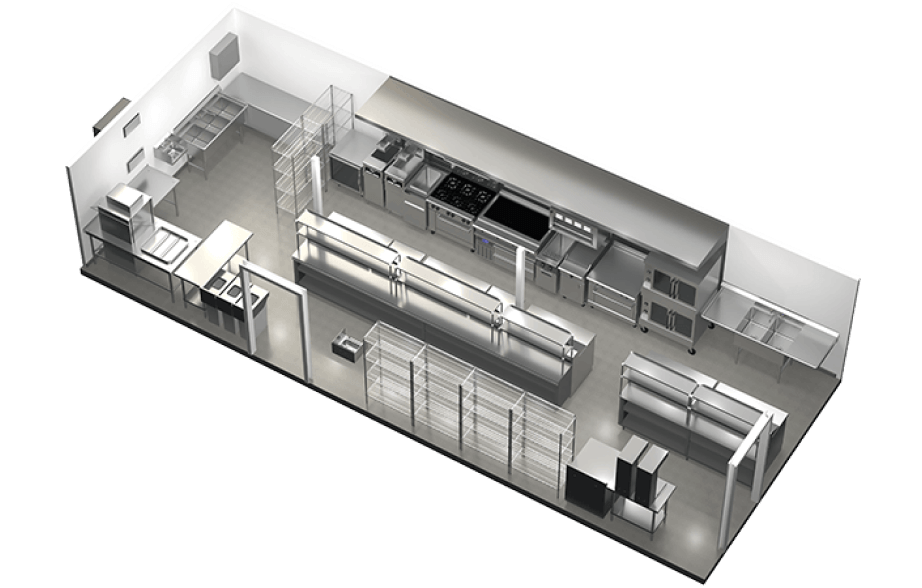
“As illustrated above, future-ready layouts reserve space for growth without disrupting current operations.”
Future growth is one of the components of space planning that is most neglected. However, integrating this consideration early helps ensure your kitchen remains adaptable and efficient as needs change.
Early planning should take into account:
- Extra equipment capacity
- An increase in employee mobility
- Increased storage requirements
- Expansion of utility load
When demand rises, kitchens designed only for current volume often struggle to keep up. Kitchens that allocate buffer space, however, adapt more easily without extensive remodeling.
Scalability planning, in my experience, ultimately saves substantial time and money.
How to Approach Early-Stage Space Planning
I suggest a methodical approach when counseling teams during the concept stage:
- Describe the service type and business model.
- Calculate the maximum production volumes.
- Before deploying equipment, map the workflow and assign space zone by zone.
- Verify access, utilities, and clearances.
- Examine the requirements for scalability.
By employing this approach, commercial kitchen space planning is positioned to support both current operations and future growth. Having established these foundational principles, it is now useful to explore several frequently asked questions that often arise during the planning process.
Frequently Asked Questions
How much room is required for a commercial kitchen?
No size is set in stone. Volume, service model, and menu all affect space.
Is it possible to plan small kitchens effectively?
Indeed. Compact kitchens can be extremely functional with careful equipment placement and clear zoning.
Should equipment selection come after space planning?
Indeed. Equipment choices should be based on workflow and zoning, not the other way around.
Does compliance depend on space planning?
Of course. Sufficient distance promotes cleanliness, fire safety, and preparedness for inspections.
Can inadequate space planning be fixed at a later time?
Redesigns are expensive and disruptive, yet some problems can be resolved.
Final Thoughts and Planning Takeaways
Space planning isn’t just a technical requirement. It shapes a kitchen’s daily operation and long-term efficiency.
When space is managed well, workflows flow smoothly, safety improves, upkeep becomes easier, and scaling makes sense. Poor planning makes every service a workaround. Spend time obtaining space before committing to layouts or equipment if you are in the early stages of development. Commercial kitchens that are effective, compliant, and prepared for the future are built on a solid foundation of space planning.