Table of Contents
- Why Operational Efficiency Defines Kitchen Success
- What Operational Efficiency Means in a Commercial Kitchen
- How Workflow Design Impacts Daily Performance
- Role of Layout and Zoning in Efficiency
- Equipment Planning for Faster Operations
- Staff Coordination and Process Discipline
- Maintenance and Downtime Prevention
- Measuring and Improving Efficiency Over Time
- Frequently Asked Questions
- Final Thoughts and Process Improvement Takeaways
Why Operational Efficiency Defines Kitchen Success
Inefficiency is usually the primary reason why kitchens fail to grow or maintain profitability.
A kitchen’s ability to turn labor, energy, food, and time into consistent results depends on how efficiently it operates. Even minor inefficiencies accumulate in busy kitchens: slow prep disrupts service, equipment breakdowns hit revenue, and uncoordinated staff drive up labor costs.
Kitchens that focus on efficiency enjoy smoother shifts, fewer breakdowns, and can grow more easily. Improving efficiency isn’t a one-time fix. It’s an ongoing process.
What Operational Efficiency Means in a Commercial Kitchen
Practically speaking, operational efficiency refers to producing the necessary results with the least amount of motion, time, energy, and resource loss.
This comprises:
- Staff and food flow smoothly
- Very little time spent waiting between activities
- Regular production during busy times
- Reliable service schedules
- Reduced operating expenses
Speed is not the only factor in efficient kitchens. They depend on order. Teams compensate with effort when there is no structure, but this is unsustainable.
How Workflow Design Impacts Daily Performance
The foundation of efficiency is workflow.
Workflow in effective kitchens proceeds logically from receiving to storing, preparing, cooking, plating or dispatching, and cleaning. Every stage is arranged to minimize path crossings and backtracking.
When kitchens have clear steps for each task, they see fewer slowdowns during busy times. Well-structured workflows let teams focus on cooking instead of figuring out where to go next.
Simply rethinking how work gets done can often boost productivity. No extra staff or gear required.
Role of Layout and Zoning in Efficiency
Zoning and layout directly impact a kitchen’s operational efficiency.
· Prep does not interfere with cooking when there is clear zoning.
· Waste and dishwashing do not come into contact with food.
· During servicing, dispatch is unhindered.
Kitchens with specific zones (rather than undefined open spaces) keep running smoothly, even when things get hectic. Good zoning means less running around and less confusion.
Equipment Planning for Faster Operations
Workflow should be facilitated by equipment, not hindered.
Effective equipment planning takes into account:
· Regularity of usage
· Closeness to related tasks
· Requirements for ventilation and heat
· Access for cleaning and maintenance
Many kitchens pack in gadgets they rarely use, or put important tools in the wrong spots. This leads to crowding and slowdowns.
Smart kitchen setups put the most-used equipment where it’s needed. This makes work faster and more predictable than simply cramming in more tools.
Staff Coordination and Process Discipline
Space and equipment are not the primary factors in efficiency. It also has to do with people.
Kitchens that perform well use:
- Roles that are clearly defined
- Standard operating procedures
- Task handoff points that are predictable
- Very little overlap between tasks
When employees know where to work, when to move, and how tasks relate to one another, productivity organically increases. During peak hours, process discipline lowers mistakes, rework, and stress.
Experience has shown that kitchens that prioritize process clarity function better than those that depend on individual effort.
Maintenance and Downtime Prevention
When equipment is faulty, operational efficiency rapidly declines.
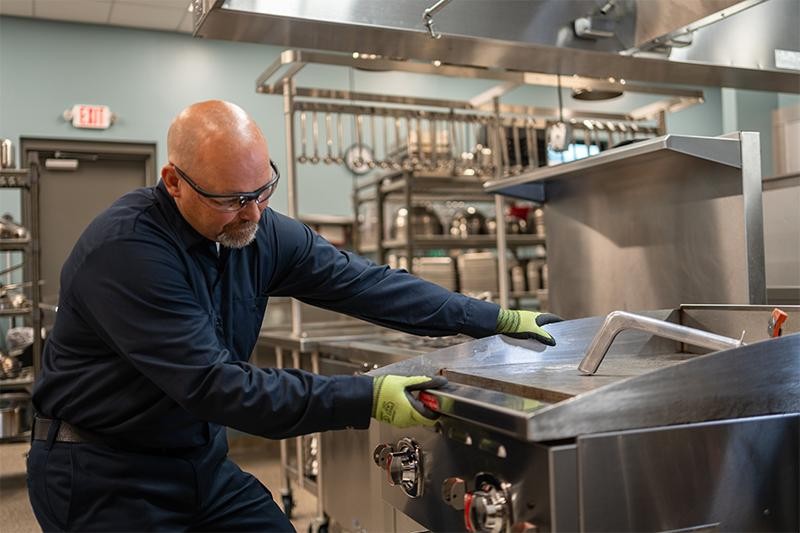
Surprise breakdowns make everyone’s job harder and throw off the whole kitchen. Staying efficient means taking care of maintenance before things go wrong.
Effective kitchens:
· Plan routine maintenance for your equipment.
· Examine and clean the ventilation systems.
· Track the effectiveness of the refrigeration system.
· Proactively replace worn-out parts. Regular checkups keep a kitchen running smoothly for the long haul, while waiting for things to break only cause chaos.
Measuring and Improving Efficiency Over Time
Don’t just assume your kitchen is efficient. Measure it.
Among the useful markers are:
· Production per worker hour
· Average order completion time, Frequency of equipment outages
· Trends in energy and utility use
By regularly checking these numbers, kitchens can spot problems early and fix them before they grow. The best kitchens don’t just stay stable. They get better over time.
Frequently Asked Questions
Is it possible to increase efficiency without hiring more personnel or purchasing more equipment?
Indeed. Optimizing workflow and layout frequently results in benefits without the need for more resources.
Does efficiency lower the quality of food?
No. Processes that are well-designed increase consistency without compromising quality.
When is the best time to start efficiency planning?
During the design and idea phases. It costs more to retrofit efficiency later.
Does efficiency matter more in large kitchens?
Every size is affected, although huge enterprises are more quickly affected by inefficiencies.
Who should be in charge of initiatives to increase efficiency?
Design, equipment, and maintenance partners should assist operators in taking the lead.
Final Thoughts and Process Improvement Takeaways
Efficiency isn’t about rushing. It’s about working smarter.
When a kitchen runs efficiently, everyone knows what to do, things work as they should, and service is steady. This doesn’t happen by accident. It comes from planning, good habits, and always looking for ways to improve.
Examine workflow, layout, equipment placement, and maintenance procedures together to increase the operational efficiency of your commercial kitchen. When all of these components function as a system, efficiency is produced.