Table of Contents
- Why Testing Before Handover Is Non-Negotiable
- What I Mean by Commercial Kitchen Testing Procedures
- Equipment Performance Testing
- Utility and Electrical Load Testing
- Ventilation and Airflow Verification
- Fire Safety and Emergency System Testing
- Workflow Simulation and Operational Validation
- Documentation and Final Handover Protocol
- Frequently Asked Questions
- Final Thoughts on Quality Assurance
Why Testing Before Handover Matters
Just because a kitchen looks finished doesn’t mean it’s ready to use. Real-world testing is the only way to know if everything works as it should.
Most early problems happen when systems aren’t tested properly under real conditions. Testing helps avoid last-minute surprises when staff start working or during busy times.
That’s why thorough testing is a key part of handing over a professional kitchen.
What are Commercial Kitchen Testing Procedures?
The systematic validation process carried out after installation and before handover is what I mean when I talk about commercial kitchen testing processes.
This involves confirming that:
- Under operational load, the equipment operates.
- Utilities allow for concurrent use.
- Ventilation efficiently absorbs heat and smoke.
- Safety systems react appropriately.
- Workflow is unhindered.
A constructed space becomes a working production environment through testing. Handover is merely a formality without this step.
Equipment Performance Testing
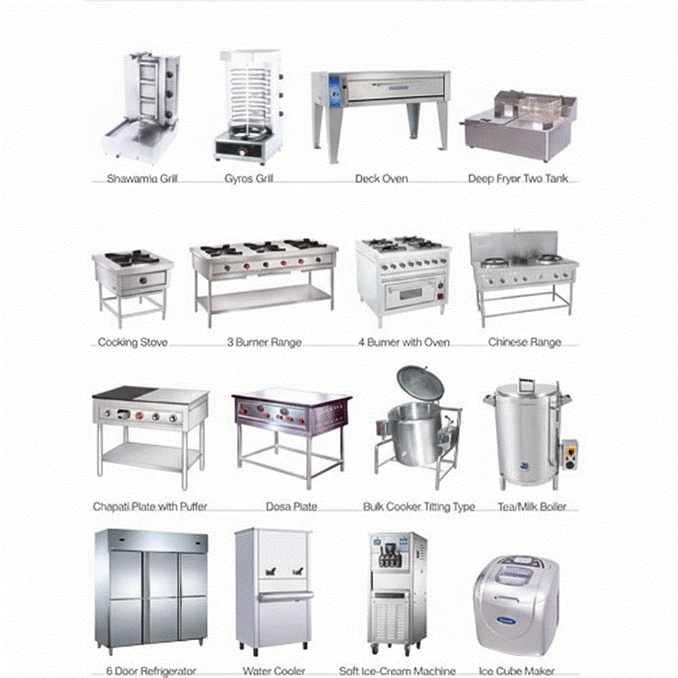
Every piece of equipment needs to be tested in real-world operating environments.
Common checks consist of:
- Maintaining full temperature in fryers, ovens, ranges, and combi units
- Checking the stability of the refrigeration temperature
- Dishwashers are tested using full cycles.
- Verifying that safety cut-offs and control panels operate as intended
After these tests are finished, I watch how the equipment responds to simultaneous operation. Even though a single piece of equipment may work flawlessly, its combined use may reveal electrical or load distribution problems. This step validates performance in the real world rather than theoretical abilities.
Utility and Electrical Load Testing
Once connected, utilities are often taken for granted as accurate. Testing confirms the opposite.
Important validation procedures consist of:
- Electrical load measurement at periods of high usage
- Verifying the stability of gas pressure while operating many pieces of equipment
- Verifying drainage flow and water pressure
- If necessary, test backup power systems.
Load testing guarantees that the infrastructure supports the operational design. Without it, during service, kitchens could experience drainage backups, irregular gas supply, or tripped circuits. Before opening, these dangers are eliminated through proper validation.
Ventilation and Airflow Verification
Compliance, comfort, and safety all depend on ventilation efficacy.
This phase entails:
- Simultaneously operating kitchen appliances
- Monitoring hood efficiency and smoke capture
- Checking the balance of make-up and exhaust air
- Assessing the workspace’s heat dispersion
Ventilation systems must support the entire cooking load. Visual scrutiny is not enough on its own. Testing verifies that working conditions remain safe and compliant, and that airflow dynamics operate as planned.
Fire Safety and Emergency System Testing
Before being turned over, safety systems need to be verified under controlled circumstances.
Testing consists of:
- Verify the triggers for the fire suppression systems.
- Emergency shut-off valve inspection
- Verifying that extinguishers are accessible
- Verifying that detection and alarm systems operate as intended
These inspections ensure that emergency systems are functional and installed. A well-tested safety system safeguards employees and capital.
Workflow Simulation and Operational Validation
The kitchen needs to be tested as an operating environment in addition to its technical systems.
This comprises:
- Replicating the conditions of peak service
- Keeping an eye on employees moving between zones
- Finding areas of congestion
- Verifying access for upkeep and cleaning
Subtle layout inefficiencies that are impossible to predict from drawings are frequently revealed via operational simulation. Corrections after opening are far more difficult than adjustments at this point.
Documentation and Final Handover Protocol
Without documentation, testing is not complete.
Before transfer, I make sure:
- Reports on the equipment’s performance are documented.
- The outcomes of utility tests are recorded.
- Checks for compliance are recorded.
- Any remedial measures are approved.
The results of commercial kitchen testing processes are formalised through documentation. By proving that the kitchen has undergone methodical validation, it safeguards both the operator and the execution partner.
Frequently Asked Questions
Before opening, are testing procedures required?
They are necessary for operational reliability even though they aren’t always formally required.
What is the duration of testing?
It usually lasts from a few days to a few weeks, depending on the project’s scope.
Can problems found during testing delay handover?
Yes, however, addressing issues before opening helps avoid far more significant interruptions later.
Does commissioning differ from testing?
A crucial part of commissioning is testing, which concentrates on system validation.
Who should be in charge of testing protocols?
The execution partner usually oversees testing in a turnkey model, seeking expert input when necessary.
Final Thoughts on Quality Assurance
Testing is a necessary last step. It serves as a safety measure.
Workflow, utilities, ventilation, safety systems, and equipment all function as a single, integrated system when commercial kitchen testing processes are carried out correctly. This phase establishes the distinction between operational readiness and installation completion.
Before handover, quality assurance safeguards long-term performance, compliance results, workforce confidence, and timelines.