Table of Contents
• Why Execution Model Choice Impacts Kitchen Performance
• What is Turnkey Kitchen Execution?
• Design and Execution Alignment Differences
• Multiple Vendors and Split Accountability
• Equipment, Utilities, and Ventilation Coordination
• Compliance and Inspection Challenges
• Timeline Risks Due to Poor Sequencing
• How to Reduce Execution Risks in Kitchen Projects
• Frequently Asked Questions
• Final Thoughts and Industry Takeaways
How the Choice of Execution Model Affects Kitchen Performance
Planning a commercial kitchen often focuses on equipment quality, but success depends more on effective coordination among all parties.
A professional kitchen project brings together designers, equipment suppliers, LPG contractors, electricians, ventilation specialists, and fire consultants. Without early alignment, minor technical issues can escalate and cause project delays.
For example, finalizing electrical load before confirming the equipment list can cause complications like panel upgrades when new appliances are added, slowing progress and increasing costs.
The chosen project model at the outset sets the stage for how such challenges are managed throughout the process.
What is Turnkey Kitchen Execution?
Turnkey kitchen execution refers to a single partner overseeing planning, supply, installation, and commissioning.
This typically includes:
• Layout and workflow planning
• Equipment selection based on projected service volume
• Stainless steel fabrication
• Electrical, gas, plumbing, and ventilation integration
• Testing and operational handover
Rather than separating design and execution, the process is continuous. Validating drawings against actual utility capacities before installation prevents complications.
This prevents conflicts during commissioning.
Design and Execution Alignment Differences
Many projects have approved layouts that appear ideal in theory but encounter issues during installation.
Common gaps include:
• Equipment footprints exceeding available clearance
• Utility routing clashing with structural beams
• Insufficient access for maintenance
• Ventilation sizing not matching the cooking load
If not validated early, these issues must be corrected later, resulting in increased costs and delays.
Alignment is not about appearance but about efficient buildability.
Multiple Vendors and Split Accountability
In multi-vendor structures, responsibilities are divided.
Typically:
• One party prepares the layout
• Another supplies equipment
• Another installs ventilation
• Compliance is reviewed separately
If ventilation coverage changes due to revised equipment load, who is responsible? If gas pressure drops during peak operation, who validates it?
Fragmented accountability leads to reactive coordination.
This is where the turnkey kitchen vs multiple vendors decision becomes a structural decision about responsibility.

Equipment, Utilities, and Ventilation Coordination
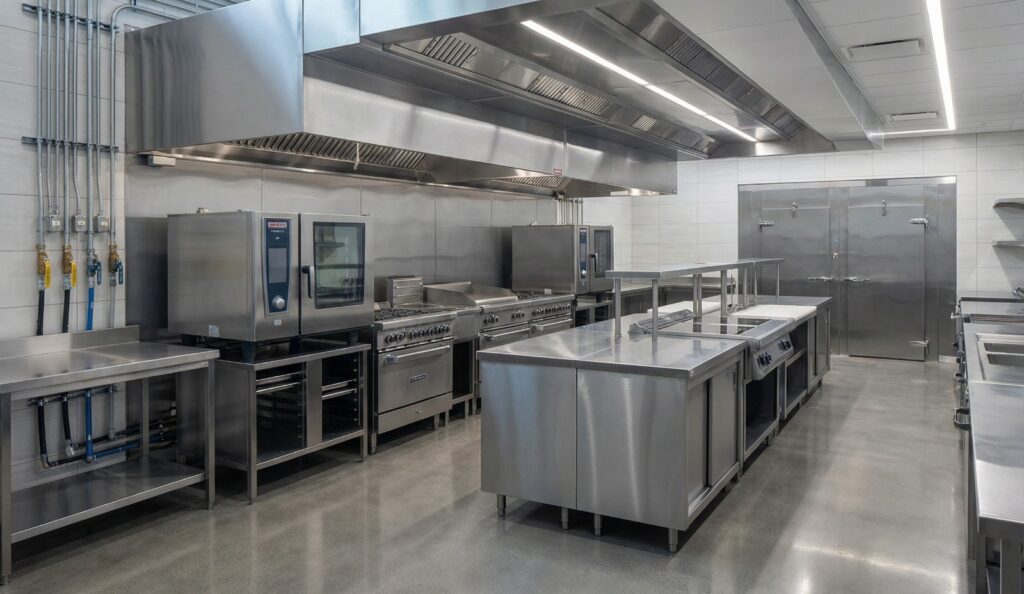
In a commercial kitchen, equipment and utilities must operate as a unified system.
Core equipment usually includes:
Cooking equipment such as combi ovens, ranges, and fryers
Refrigeration, including walk-in cold rooms and reach-in chillers
Preparation stations and stainless-steel work areas
Dishwashing and grease management systems
Each of these requires proper:
Electrical load sanction
Gas pressure validation
Drainage planning
Ventilation design
In India, obtaining sanctioned electrical load approval from the local authority is mandatory before installing high-load equipment. LPG installations must follow PESO safety guidelines. Ventilation and fire suppression systems must comply with the National Building Code.
Finalizing equipment without confirming these requirements will necessitate redesign.
Compliance and Inspection Challenges
Compliance should be integrated early as a design parameter, not addressed at the end.
FSSAI Schedule 4 requires proper ventilation, cleanable surfaces, waste management, and separation of raw and cooked areas. Fire departments require safe egress, suppression systems, and correct exhaust duct clearance.
If you wait until the inspection to validate these risks modifications and delays. Early compliance integration saves time.
Timeline Risks Due to Poor Sequencing
Even technically sound kitchens experience delays from sequencing errors.
I often see:
• Equipment delivered before utilities are ready
• Ventilation installed before equipment placement is finalized
• Finishes completed before heavy installation
Unclear sequencing leads to rework. Execution order is as important as design accuracy.
How to Reduce Execution Risks in Kitchen Projects
To reduce risk, focus on structured validation.
I recommend:
• Confirming sanctioned electrical load before procurement
• Validating gas routing against peak demand
• Designing ventilation based on simultaneous cooking load
• Integrating FSSAI and fire norms during the layout stage
• Establishing a defined installation schedule
The key difference between turnkey kitchens and multiple vendors lies in how coordination and accountability are assigned and managed.
Frequently Asked Questions
Do small kitchens face coordination challenges?
Yes. Limited space increases service conflicts.
Can coordination issues be corrected during installation?
They can, but this increases time and cost.
Does turnkey eliminate all coordination risk?
No model eliminates risk, but centralized accountability reduces fragmentation.
What causes major approval delays?
Major approval delays result from late compliance integration and incomplete load validation.
When should coordination begin?
Coordination should begin during concept design, before procurement.
Final Thoughts and Industry Takeaways
When evaluating commercial kitchen projects, I focus on how coordination responsibilities are structured.
Equipment, utilities, ventilation, compliance, and sequencing must integrate; separating them causes later problems.
Choosing between turnkey kitchen vs multiple vendors is not about labels but about managing risk and accountability throughout the project lifecycle.
Projects integrating planning and execution early open more smoothly and need fewer corrections after commissioning.
For a closer look at the roles themselves, our contractor versus consultant versus equipment dealer comparison breaks down exactly where each one’s responsibility begins and ends.