Table of Contents
Why Ventilation Standards Matter
What Are Commercial Kitchen Ventilation Standards?
Key Ventilation Requirements in Commercial Kitchens
International Ventilation Standards and Codes
Airflow and Exhaust Rate Guidelines
Fire Safety and Ventilation Compliance
Inspection and Maintenance Requirements
Common Compliance Failures
Best Practices for Meeting Ventilation Standards
Why Ventilation Planning Matters
What Is Ventilation Planning in Commercial Kitchens?
Key Factors to Consider During Planning
Understanding Kitchen Layout and Ventilation
Equipment-Based Ventilation Planning
Airflow and Exhaust Planning
Role of Make-Up Air in Planning
Compliance and Safety Considerations
Common Planning Mistakes
Best Practices for Ventilation Planning
Frequently Asked Questions
Final Thoughts on Ventilation Standards
Why Ventilation Standards Matter
Comfort is only one aspect of ventilation in a commercial kitchen. It is a regulatory requirement that directly affects operational approval, safety, and hygiene.
Comprehending commercial kitchen ventilation standards guarantees that your kitchen maintains a safe working atmosphere while adhering to legal requirements. Heat buildup, grease accumulation, and major fire dangers can result from inadequate ventilation.
It is not voluntary to comply. For any commercial kitchen to operate, it is an essential prerequisite.
What Are Commercial Kitchen Ventilation Standards?
The rules and guidelines that specify how air should be controlled in a commercial kitchen are known as ventilation standards.
The main areas covered are exhaust airflow, hood systems, duct design, and makeup air delivery. The goal is straightforward: contaminated air out, clean air in.
A system that is built around these specifications keeps the risk low, air quality stable, and operations in line with safety requirements.
Key Ventilation Requirements in Commercial Kitchens
The main areas covered are exhaust airflow, hood systems, duct design, and makeup air delivery. The goal is straightforward: contaminated air out, clean air in.
A system built around these specs keeps risk low, air quality stable, and operations in line with safety requirements.
International Ventilation Standards and Codes
Ventilation requirements for commercial kitchens differ from country to country. The US follows NFPA 96 for fire safety and ventilation control. The UK uses DW/172 for kitchen ventilation systems. ASHRAE covers HVAC and airflow design broadly, and local fire and building codes apply on top of all of these.
The goal, regardless of location, stays the same: remove heat, smoke, and grease from the cooking space without cutting corners on safety.
Airflow and Exhaust Rate Guidelines
In order to achieve ventilation regulations, airflow is essential.
Important factors include:
• Appropriate exhaust airflow rates according to the kind of equipment
• Keeping the airflow constant
• Steer clear of negative pressure in the kitchen
• Making sure there is enough fresh air available
The efficiency with which pollutants are eliminated depends on these criteria.
Cooking activities can be disrupted, and system efficiency can be decreased by an imbalance in airflow. A well-thought-out system guarantees that air flows through the kitchen without causing pressure-related problems.
Fire Safety and Ventilation Compliance
Fire safety and ventilation go hand in hand in commercial kitchens. Requirements usually focus on four things: grease filtration to stop buildup, fire-resistant duct construction, integration with firefighting equipment, and routine cleaning of hoods and ducts.
Grease accumulation is a big reason behind kitchen fires. Proper ventilation design and regular upkeep are the most direct ways to manage that risk.
Inspection and Maintenance Requirements
Staying compliant comes down to maintenance. Grease filters and ducts need cleaning on a fixed schedule. Exhaust systems need periodic inspection. Airflow performance needs to be tested, and individual components need to be verified as working correctly.
Neglect any of these and efficiency drops. Let it go long enough and you have a safety violation on your hands. Regular inspections are the simplest way to catch small problems before they turn into bigger ones.
Common Compliance Failures
Many kitchens fail ventilation standards not because of complex technical problems, but because of basic ones: hoods that are too small, ductwork that was poorly designed or badly installed, airflow that cannot handle the cooking load, and maintenance schedules that get skipped.
Each of these on its own is fixable. Left unaddressed, they create real safety risks and tend to cause operational headaches at the worst possible times.
Commercial kitchen ventilation standards are routinely met and upheld when these problems are avoided.
Best Practices for Meeting Ventilation Standards
Long-term performance and compliance are ensured by adhering to best practices.
Important procedures consist of:
• Developing systems according to cooking load and equipment
• Making sure the hood is positioned and sized correctly
• Making plans for simple access to maintenance
Performing routine audits of compliance
A proactive approach to ventilation management is produced by these procedures.
A well-built system reduces risk, keeps operations smooth, and holds up under regulatory oversight.
Why Ventilation Planning Matters
Despite being one of the most important systems in a commercial kitchen, ventilation is frequently neglected until far later in the design process. Early planning guarantees that efficiency, safety, and airflow are incorporated into the kitchen from the start.
Since ventilation affects everything from equipment performance to employee comfort and regulatory compliance, it is crucial to comprehend commercial kitchen ventilation planning. Ineffective airflow, expensive redesigns, and operational disruptions can result from poor planning.
Long-term dependability and efficiency are guaranteed when ventilation is planned throughout the design phase.
What Is Ventilation Planning in Commercial Kitchens?
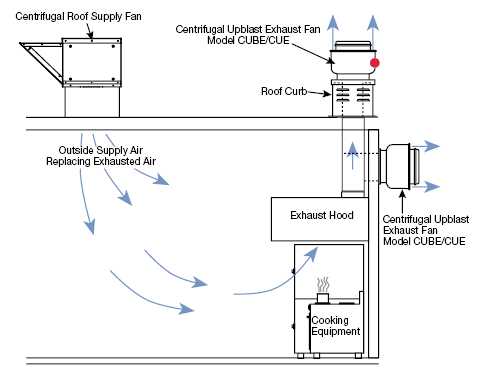
Ventilation planning includes designing the flow of air through the kitchen, from supply systems that replace contaminated air to exhaust systems that remove it.
It consists of:
• Arranging the location of the hood system
• Creating duct paths
• Determining the necessary airflow
• Including systems for make-up air
Together, these components provide a balanced ventilation system.
A well-thought-out system guarantees the efficient removal of heat, smoke, and grease while preserving steady air pressure throughout the kitchen.
Key Factors to Consider During Planning
To guarantee efficient ventilation, a number of things need to be considered during the planning stage.
Important elements consist of:
• The kind of culinary appliances utilised
• Levels of heat and grease output
• The size and design of the kitchen
• The anticipated number of operations
Every element affects the design of the system.
For instance, stronger exhaust systems are needed for high-heat appliances like grills and fryers, and careful airflow planning is necessary in smaller kitchens to maximise efficiency.
Understanding Kitchen Layout and Ventilation
Ventilation planning is heavily influenced by the kitchen’s physical layout.
Different methods are needed for different layouts:
• Cooking lines that run linearly along walls
• Cooking settings on the central island
• Small kitchen areas
• Designs for open kitchens
Every layout has different airflow problems.
In order to eliminate hot spots and guarantee effective contamination clearance, a well-thought-out commercial kitchen ventilation planning makes sure that airflow is spread uniformly throughout all zones.
Equipment-Based Ventilation Planning
The equipment utilised in the kitchen must be taken into consideration when designing ventilation systems.
Important factors include:
• Cooking appliances’ heat output
• The kind of fuel utilised
• Equipment placement
• Usage frequency
Exhaust requirements are determined by these considerations.
Contaminants are efficiently absorbed and eliminated without interfering with activities when ventilation and equipment are properly aligned.
Airflow and Exhaust Planning
Good ventilation lives or dies on airflow. Supply and exhaust have to be balanced. Negative pressure is a problem the moment it develops. Air movement needs to stay consistent, and duct routing has to suit the actual layout of the space, not just look clean on paper.
When airflow is handled properly, smoke doesn’t pool, and temperatures stay even. When it isn’t, both issues show up at the same time, and neither is easy to trace back to the source.
Role of Make-Up Air in Planning
In commercial kitchens, make-up air systems are essential for preserving the equilibrium of airflow.
They assist by:
• Replacing the air that exhaust systems remove
• Keeping pressure levels steady
• Encouraging steady airflow
• Avoiding interruptions to ventilation
These features guarantee the system’s effective operation.
Exhaust systems cannot operate efficiently without enough make-up air planning. The proper operation of ventilation systems is ensured by a balanced approach.
Compliance and Safety Considerations
Systems for ventilation must adhere to safety and hygienic regulations.
Important factors include:
• Requirements for fire safety
• Standards for grease filtering
• Appropriate duct design
• Provisions for routine inspections
Safe operations are guaranteed by compliance.
Operational problems and safety hazards may arise if these conditions are not met. Planning with compliance in mind guarantees long-term dependability and seamless approvals.
Common Planning Mistakes
Poor layout choices cause ventilation problems in many kitchens.
Typical errors consist of:
• After the layout is finalised, designing ventilation
• The wrong size of the hood
• Inadequate duct routing
• Disregarding the equilibrium of airflow
These errors may result in safety hazards and inefficiencies.
By avoiding these problems, commercial kitchen ventilation planning is guaranteed to be efficient and to promote long-term performance.
Best Practices for Ventilation Planning
Ventilation works best when it’s part of the kitchen design from day one, not something squeezed in at the end. That means doing proper airflow calculations early, keeping contractors and designers on the same page, and building something the maintenance team can actually get into when something needs fixing.
Skipping any of those steps tends to show up later, usually as uneven airflow, a safety issue, or a system that’s harder to service than it needs to be.
Frequently Asked Questions
What are the requirements for ventilation in commercial kitchens?
These rules specify the safety, exhaust, and ventilation standards for kitchens.
What makes compliance crucial?
It guarantees security, avoids risks, and permits lawful operation.
Do national standards differ?
Indeed. Certain rules and regulations are adhered to by different areas.
How frequently should systems be examined?
Regular inspections should be carried out in accordance with local laws.
Can fines result from inadequate ventilation?
Indeed. Operational shutdowns or fines may follow noncompliance.
What makes ventilation planning crucial?
From the beginning, it guarantees effective airflow, safety, and compliance.
When is the best time to schedule ventilation?
during the kitchen’s original design phase.
Does ventilation planning depend on the layout of the kitchen?
Indeed. Airflow and system design are directly impacted by layout.
Is it necessary to use makeup air?
Indeed. It is necessary to keep the balance of airflow.
Can a kitchen’s performance be impacted by inadequate planning?
Indeed. It may result in operational problems and inefficiency.
Final Thoughts on Ventilation Standards
Building a safe and compliant cooking environment requires an understanding of commercial kitchen ventilation standards.
These guidelines promote effective kitchen operations, provide adequate ventilation, and lower the risk of fire. They also contribute to a better working environment and hygienic maintenance.
Long-term compliance and dependable performance are ensured by investing in appropriate design, installation, and maintenance.
Ventilation is more than a system. It is a legal requirement that determines the efficiency of your kitchen.