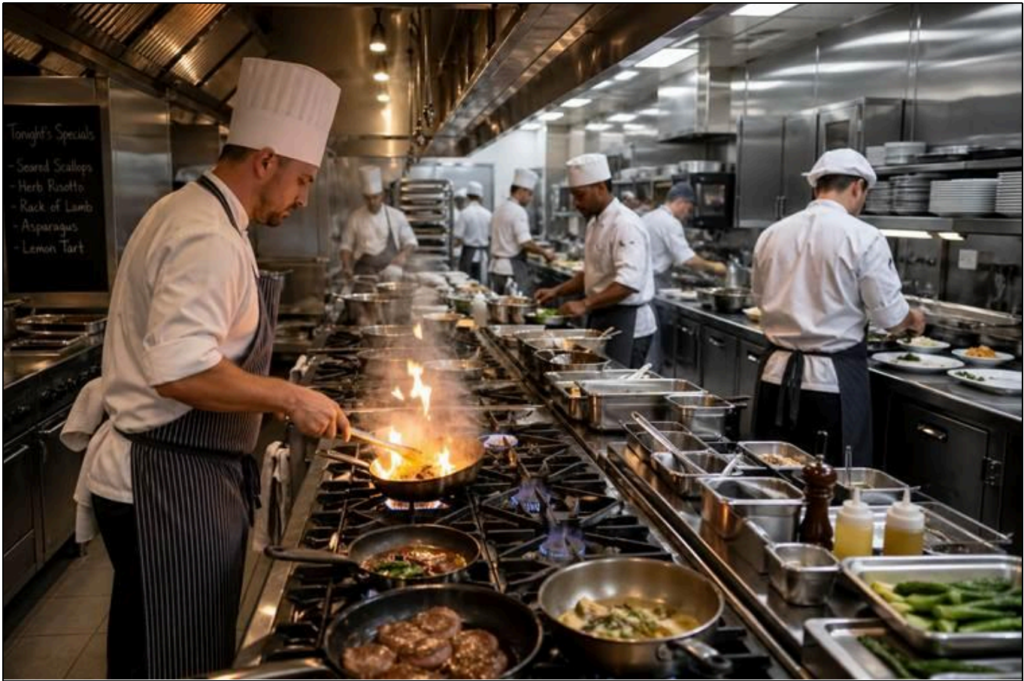
If you are setting up a professional kitchen, whether for a five-star hotel, a cloud kitchen, or a standalone restaurant, the commercial cooking range is probably the single most important piece of equipment you will choose. It determines how fast your brigade cooks, how consistent your food quality is, and frankly, how much you spend on energy every month. Gas, electric, induction — each has a real place in a commercial kitchen, and each has situations where it genuinely falls short. I have seen kitchens waste serious money by picking the wrong type simply because nobody sat down to think it through before ordering. This guide breaks down all three types in detail, compares them across the factors that actually matter in a professional kitchen in India, and helps you figure out which one, or which combination, makes sense for your operation. No fluff, just the real stuff.
What Is a Commercial Cooking Range and How Is It Different from a Domestic Stove?
A commercial cooking range is built for volume, speed, and continuous use. That is the short answer. The longer answer is that it is a completely different class of equipment from anything you buy at a home appliance store, even the premium ones. A domestic stove operates at somewhere between 1,500 and 3,500 watts per burner. A commercial gas burner, by comparison, delivers anywhere from 5 kW to 30 kW or more, depending on the type. The frame is heavy-gauge stainless steel, usually 304 grade, designed to handle constant thermal stress, heavy cookware, and daily cleaning with industrial chemicals. Domestic stoves simply are not built for that. Beyond raw power, commercial ranges are designed for workflow. You will find configurations with multiple burner rows, integrated oven bases, salamanders mounted above, griddle sections, and wok burners all on the same unit. The burner grates are cast iron, much heavier, designed so that pots do not shift when a cook is working at speed. The control knobs are robust, often with brass gas valves rated for thousands of cycles. I think the simplest way to explain the difference is this: a domestic stove is designed for one person cooking one dish. A commercial cooking range is designed for four cooks cooking twenty dishes simultaneously, doing it eight to sixteen hours a day, every single day. The engineering behind them is not even comparable.
Key Technical Differences at a Glance
- BTU/kW output: Commercial ranges deliver 3x to 10x more heat than domestic stoves
- Construction material: 304-grade stainless steel versus painted mild steel or ceramic
- Burner design: Cast iron grates, separate pilot or electronic ignition per burner, heavier brass valves
- Regulatory compliance: Commercial equipment must meet BIS standards and fire safety codes in India
- Ventilation requirement: All commercial cooking ranges require a properly designed exhaust hood system
- Warranty and service: Commercial units come with different service agreements designed for continuous operation
What Are the Types of Commercial Cooking Ranges Available in India?
There are three primary types used in professional kitchens in India: gas, electric, and induction. Within each, there are sub-types and configurations. Here is how they break down.
1. Commercial Gas Cooking Range
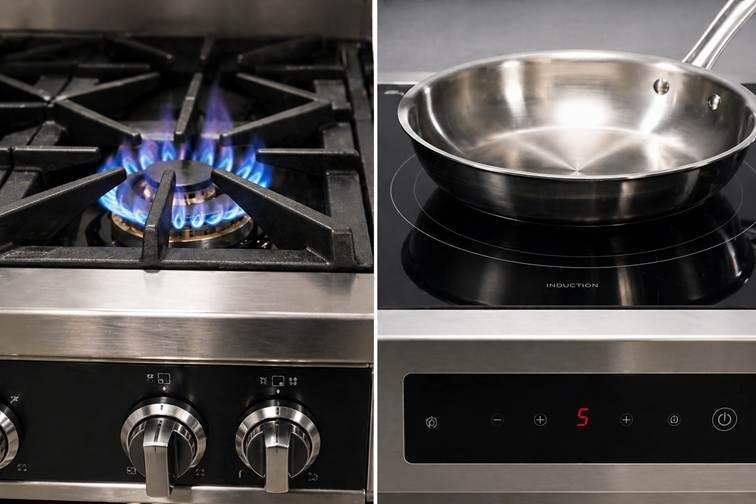
This is still the dominant choice across hotel and restaurant kitchens in India. Commercial gas ranges run on either LPG or PNG (piped natural gas), depending on your city and building infrastructure. They use open-flame burners, and they heat cookware through direct contact between the flame and the vessel bottom.
Within gas ranges, you have several configurations. The most common in Indian kitchens is the Chinese or wok range, which uses a recessed ring burner with very high BTU output, usually between 20,000 and 35,000 BTU per burner. These are ideal for high-heat stir-frying, tossing, and any cooking technique that requires rapid temperature changes. Then you have the European-style commercial gas range with sealed burners or open burners and an oven base underneath, which suits continental kitchens and bakery operations. Indian ranges with cast iron pot supports and individual burner rings are also common in mid-scale restaurant setups.
Typical burner counts range from 2-burner countertop units to 6-burner or 8-burner
floor-standing ranges. Some Indian manufacturers offer modular configurations where you combine a 4-burner section with a griddle section and a stock pot section all in one straight run.
2. Commercial Electric Cooking Range
Electric ranges use resistive heating elements, either exposed coil burners or solid hotplate burners, to generate heat. They are less common in India compared to gas, mostly because electricity costs here make continuous high-output cooking expensive over time.
That said, they do have genuine advantages. There is no open flame, which simplifies certain fire safety certifications. They are easier to clean because the surface is flat. And in locations where gas supply is not available or reliable, they become the only practical alternative. Electric ranges are also sometimes used in specific kitchen sections, particularly pastry or sauce stations, where very low, controlled heat is needed and a gas burner’s minimum output is still too aggressive.
3. Commercial Induction Cooking Range
Induction is the newest of the three in widespread commercial use and probably generates the most questions from hotel kitchen planners I speak with. A commercial induction range uses electromagnetic coils to generate heat directly inside the cookware, not on the surface of the range itself. The cooktop surface stays relatively cool; only the vessel heats up.
Commercial induction units are available as single hobs, double hobs, or built-in modular configurations that can be integrated into a custom counter. Output ranges from around 3 kW for lighter units to 8 kW and above for heavy-duty commercial models. Some high-output induction wok cookers go up to 15 kW or even 20 kW, bringing their performance much closer to gas wok burners than people might expect.
One thing worth noting for Indian kitchens specifically: induction requires flat-bottomed, ferromagnetic cookware. Traditional Indian karais and round-bottomed woks simply do not work on induction without an adapter plate, and even with an adapter, performance drops. This is a real operational constraint in kitchens serving Indian cuisine, not just a theoretical limitation.
Is a Gas or Induction Commercial Range Better for a Hotel Kitchen?
This is probably the question I get most often when working on kitchen planning projects for hotel clients. And honestly, the answer is it depends on your menu, your kitchen layout, your fire NOC requirements, and your long-term running cost tolerance. Let me compare them properly across the factors that matter.
Heat Control and Cooking Performance
Gas gives you instant, visible, responsive flame. A cook can read it, adjust it by feel, and work with it intuitively. For high-heat techniques like sauteing, flambeeing, charring, and wok tossing, gas is still unmatched in how natural it feels to work with. Induction, on the other hand, responds fast and holds temperature very precisely. For sauce work, chocolate tempering, sous vide adjacent cooking, and anything requiring consistent low heat, induction is arguably better. The issue is that most Indian and Chinese cuisine relies heavily on
high-heat techniques and round-bottomed cookware, and induction struggles on both counts without significant adaptation.
Energy Efficiency
Induction wins clearly on paper. Commercial induction units are typically around 85 to 90 percent energy efficient, meaning most of the electricity consumed goes directly into heating the food. Commercial gas burners, even well-maintained ones, are somewhere around 40 to
55 percent efficient because a significant portion of the heat goes into the ambient kitchen air. However, in India, the cost per unit of LPG or PNG is often lower than electricity per equivalent energy output, which partially offsets this efficiency gap. The actual running cost calculation depends heavily on your local energy tariff and cooking volume.
Kitchen Temperature and Ventilation
This is one area where induction has a clear, practical advantage in Indian conditions. Commercial kitchens in India already run extremely hot, particularly during summer. Gas burners add significant radiant heat to the kitchen environment, raising ambient temperatures and putting more load on your HVAC and exhaust system. Induction surfaces stay cool, and the heat generated is concentrated in the cookware rather than the room. For hotel kitchens in warm climates, this translates to a more comfortable working environment and potentially lower cooling costs.
Installation and Infrastructure
Gas requires a gas line connection, either an LPG manifold setup or a PNG connection, along with all the associated safety valves, flexible hose connections rated for commercial use, and a proper fire NOC. Induction requires a stable three-phase power supply with sufficient load capacity, which is not always available in older buildings or tier-2 city locations. Both have infrastructure requirements; the question is which infrastructure your property already supports.
Safety
Induction is safer in terms of fire and burn risk. There is no open flame, no risk of gas leakage, and the cool surface means incidental contact burns are far less likely. Gas kitchens require proper gas leak detection systems, flame failure safety devices, and trained staff on gas safety protocols. In my experience, neither is inherently unsafe when properly installed and maintained, but induction does reduce the number of potential failure points.
Quick Comparison Table: Gas vs Electric vs Induction
| Factor | Gas | Electric | Induction |
| Heat Output | Very High (up to 35,000 BTU) | Medium | High (up to 20 kW) |
| Energy Efficiency | 40-55% | 70-75% | 85-90% |
| Running Cost (India) | Low to Medium | High | Medium |
| Cookware Flexibility | All types | All types | Ferromagnetic only |
| Kitchen Heat Added | High | Medium | Low |
| Best For | Indian/Chinese/Continental | Pastry/Sauce stations | European/Pastry/Fine Dining |
What Size Commercial Cooking Range Does a Restaurant Need?
Sizing a commercial cooking range is not just about picking a number of burners. It is about understanding your covers per service, your menu complexity, your kitchen layout, and how many concurrent cooking tasks your chefs need to run at peak.
A rough rule of thumb I use when planning kitchens: for every 30 to 40 covers per service, you typically need around 4 to 6 active burners, assuming a moderately complex menu. A 100-cover restaurant with a full a la carte menu will generally need at least 8 to 10 burners across its hot cooking line, plus additional sections for stocks, sauces, and speciality items. A cloud kitchen running 3 to 4 cuisines simultaneously might need more.
Sizing by Kitchen Type
- Small restaurant or cafe (30-50 covers): 4-6 burner range, countertop or floor-standing, often with a single oven base
- Mid-scale restaurant (80-150 covers): 6-8 burner range, often combined with a griddle section and a separate stockpot range
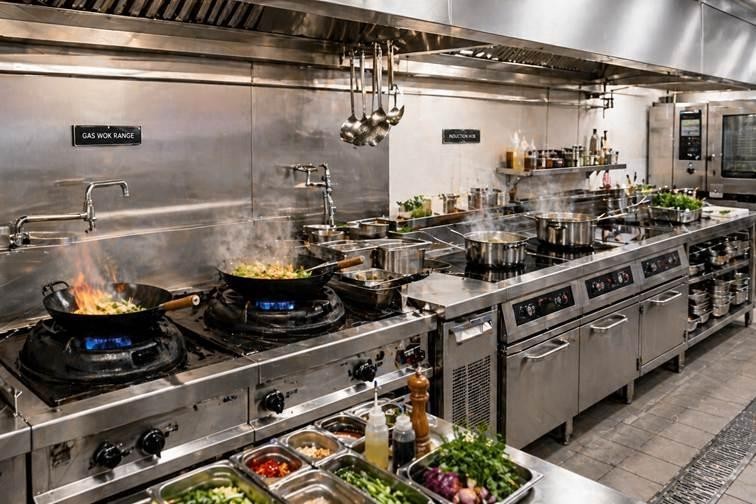
- Hotel all-day dining kitchen (200+ covers): Multiple cooking lines, typically a combination of a 6-burner European range, a 2-3 wok burner station, and a separate sauce range
- Cloud kitchen (multi-brand): Modular setup, often 2-3 separate 4-burner units rather than one large range, for operational flexibility between brands
- Banquet kitchen: High-volume equipment prioritized, large stock pot ranges, tilting kettles, and batch cooking equipment alongside conventional ranges
Beyond burner count, you also need to think about the oven base. If your menu includes roasting, baking, or finishing dishes in the oven, an oven base under your range is essential.
Standard commercial oven base configurations are usually a single half-size oven or a full-size oven rated for temperatures up to 250 to 300 degrees Celsius. For serious baking operations, a standalone deck oven is usually a better choice than relying on a range-base oven.
One more thing: do not forget the depth and height of the equipment relative to your exhaust hood. Your cooking range must sit within the capture zone of the hood, and the hood should extend at least 150 to 200mm beyond the front edge of the range on all sides. We have seen projects where expensive equipment was installed only to fail fire inspection because the range depth was not accounted for in the hood sizing. Getting the layout right before equipment is ordered is critical, and this is precisely the kind of thing that kitchen consultants spend time on during the design phase.
How Much Does a Commercial Cooking Range Cost in India?
Pricing in India for commercial cooking ranges varies significantly depending on the type, brand, configuration, and whether the equipment is domestically fabricated, imported, or a combination of both. Here is a realistic picture of what to expect as of 2024-2025.
Gas Cooking Ranges
- Entry-level 4-burner domestic/semi-commercial gas range: Rs. 8,000 to Rs. 20,000 (not recommended for serious commercial use)
- Mid-range commercial 4-burner gas range with oven base (Indian brands): Rs. 35,000 to Rs. 70,000
- Heavy-duty 6-burner commercial gas range with oven (Indian or imported): Rs. 80,000 to Rs. 1,80,000
- High-output wok range, 2-3 burner commercial (Chinese or Indian fabrication): Rs. 40,000 to Rs. 1,20,000
- European imported commercial gas range (Electrolux Professional, Giorik, etc.): Rs. 250,000 to Rs. 800,000+
Induction Cooking Ranges
- Single commercial induction hob (3-5 kW): Rs. 12,000 to Rs. 30,000
- Double induction hob, commercial grade: Rs. 25,000 to Rs. 60,000
- High-output induction wok cooker (8-15 kW): Rs. 60,000 to Rs. 150,000
- Modular built-in induction suite (European brands): Rs. 300,000 to Rs. 1,000,000+
Electric Cooking Ranges
- Commercial electric hotplate range (2-4 plate): Rs. 15,000 to Rs. 50,000
- Imported electric ceramic or solid hotplate ranges: Rs. 80,000 to Rs. 300,000+ A few important notes on pricing in India. First, GST at 18 percent applies to most commercial kitchen equipment, so always confirm whether a quoted price is inclusive or exclusive of GST. Second, installation costs, particularly for gas line connections and electrical load upgrades for induction, are separate and can add Rs. 15,000 to Rs. 1,00,000 depending on the complexity. Third, imported equipment often comes with a lead time of 8 to 14 weeks, which needs to be factored into your project timeline. Fourth, annual maintenance contracts (AMCs) for commercial kitchen equipment typically run between 8 and 12 per cent of equipment value per year and should be budgeted from the start.
I would generally caution against buying the cheapest available option in this category. A commercial cooking range that fails under load, or that starts developing gas valve issues at 18 months, will cost you far more in repair bills, downtime, and food waste than the savings you made upfront. This is one area where buying slightly above your apparent budget often makes more economic sense over a 5 to 7 year ownership horizon.
What Are the Safety Standards for Commercial Gas Ranges in India?
Safety compliance is non-negotiable in a commercial kitchen, and it is an area that does not get nearly enough attention during procurement. Here is what you need to know if you are buying or specifying a commercial gas cooking range for a hotel or restaurant in India.
BIS Certification
The Bureau of Indian Standards (BIS) governs the certification of commercial cooking equipment in India. Gas cooking appliances for commercial use fall under IS 4246 (domestic LPG stoves) and IS 15558 (commercial LPG/PNG equipment), among other relevant standards. When purchasing a commercial gas range, you should ask the supplier for the BIS certification or CE marking for imported equipment. Not all equipment available in the Indian market carries proper certification, particularly in the mid- to lower-price segment.
Fire NOC Requirements
Hotels and large restaurants in India require a Fire NOC (No Objection Certificate) from the local fire department. The inspection will look at your gas piping layout, the material and
rating of gas hoses, the presence of manual shut-off valves accessible from outside the kitchen, gas leak detection systems, and fire suppression systems above the cooking range. The exact requirements vary by state but are broadly guided by the National Building Code of India 2016 (NBC 2016) and local fire codes. Ensure your kitchen designer is working with these codes from the planning stage, not retrofitting compliance after the fact.
Gas Hose and Connection Standards
Only ISI-marked flexible gas hoses should be used for commercial kitchen connections. These hoses have a rated pressure tolerance and must be replaced at the intervals specified by the manufacturer, typically every 2 to 3 years for commercial use. Metal armoured hoses are preferred in commercial settings over rubber hoses due to their durability and resistance to mechanical damage.
Flame Failure Devices
Better quality commercial gas ranges include a flame failure device (FFD) or thermocouple on each burner, which automatically shuts off the gas supply if the flame is extinguished.
This is a standard safety feature in European and high-end imported equipment. Many locally fabricated ranges at lower price points do not include this, which is a meaningful risk in a busy kitchen where burners are frequently turned on and off and staff are not always watching every station. Specifying FFDs should be a mandatory requirement, not an optional upgrade.
Ventilation and Exhaust Hood Compliance
Any commercial cooking range, regardless of type, must operate under a properly designed exhaust canopy hood. The hood must have sufficient capture velocity to remove combustion gases, steam, smoke, and grease-laden vapour from the kitchen. In India, commercial kitchen exhaust systems should conform to NBC 2016 norms and, for hotel projects, the relevant ASHRAE guidelines for exhaust capture. A common mistake is undersizing the exhaust hood to save cost, which then results in poor air quality, grease buildup on surfaces, and eventual fire risk. The hood, the exhaust fan, the fire suppression system, and the cooking range should be designed as a system, not as individual pieces of equipment.
Planning Your Commercial Kitchen Range Setup: Where Jacio Indicius Comes In
Choosing the right commercial cooking range is genuinely complex when you factor in all the variables: menu requirements, kitchen layout, available utilities, fire compliance, budget cycles, and long-term maintenance. And frankly, most of the mistakes I have seen happen not because someone made a bad choice between gas and induction, but because the choice was made in isolation without a full picture of how the range connects to everything else in the kitchen.
At Jacio Indicius, we approach kitchen planning as an integrated process. We do not supply equipment and walk away. Our consultancy work starts with understanding your menu, your covers, your service model, and your property infrastructure. From there, we develop a CAD layout that places equipment correctly relative to workflow zones, exhaust systems, utility connections, and compliance requirements. Equipment selection, including the commercial cooking range, happens within that context.
We work with high-end hotels, resorts, and hospitality developments across India, and we handle everything from the initial design brief through to on-site installation and commissioning. Our after-sales support includes preventive maintenance programmes to keep your equipment running at specification. If you are at the planning stage of a new kitchen project or considering an upgrade to an existing kitchen, we are happy to start with a consultation.
You can reach us through jacioindicius.com to discuss your project requirements.
Frequently Asked Questions
Q: What is a commercial cooking range, and how is it different from a domestic stove? A: A commercial cooking range is a heavy-duty professional appliance built for continuous, high-volume use in restaurants, hotels, and other food service operations. It delivers
significantly more heat output than a domestic stove, uses heavier construction materials like
304-grade stainless steel, and is designed for the demands of a professional kitchen environment, including multiple concurrent burner use, daily industrial cleaning, and long operating hours.
Q: Which is better for an Indian hotel kitchen: gas or induction?
A: For most Indian hotel kitchens, a hybrid approach works best. Gas ranges remain preferable for Indian and Chinese cuisine sections due to high heat output and compatibility with all cookware, including round-bottomed vessels. Induction is better suited to fine dining, European, or pastry sections where precise temperature control and a cooler kitchen environment are priorities. The best kitchen design typically incorporates both based on the menu and workflow.
Q: How much does a commercial cooking range cost in India?
A: Prices range from around Rs. 35,000 for a basic commercial 4-burner gas range from an Indian brand to Rs. 8,00,000 or more for imported European commercial ranges. Induction units range from Rs. 12,000 for single hobs to Rs. 10,00,000+ for full modular suites. The budget should also include installation, electrical or gas connection upgrades, and annual maintenance.
Q: What size commercial cooking range does a restaurant need?
A: A rough guideline is 4 to 6 burners per 30 to 40 covers per service for a moderately complex menu. A 100-cover restaurant typically needs 8 to 10 burners across its hot line. Exact requirements depend on menu complexity, cuisine type, and concurrent cooking tasks at peak service.
Q: What safety certifications should a commercial gas range have in India?
A: Look for BIS certification under IS 15558 for commercial LPG/PNG equipment, or CE marking for imported equipment. Ranges should include flame failure devices on each burner, use ISI-marked gas connections, and be installed in compliance with NBC 2016 fire safety norms and local Fire NOC requirements.
Q: Can I use induction for Indian cuisine in a commercial kitchen?
A: Yes, but with important caveats. Induction requires flat-bottomed, ferromagnetic cookware, which means traditional round-bottomed Indian karais and woks do not work efficiently on induction. High-output commercial induction wok cookers are available and can handle many Indian cooking techniques, but a full Indian cuisine kitchen relying entirely on induction would require a significant shift in cookware and some cooking techniques.
Related Reading from Jacioindicius
- Why Equipment Commissioning Is Critical in Commercial Kitchens — https://jacioindicius.com/why-equipment-commissioning-is-critical-in-commercial-kitchens/
- Standards to Follow for Commercial Kitchen Equipment — https://jacioindicius.com/standards-to-follow-for-commercial-kitchen-equipment/
- Integrating Equipment in a Turnkey Commercial Kitchen — https://jacioindicius.com/integrating-equipment-in-a-turnkey-commercial-kitchen/
- Safety Considerations for Commercial Kitchen Equipment — https://jacioindicius.com/safety-considerations-for-commercial-kitchen-equipment/
- How Equipment Layout Impacts Kitchen Efficiency — https://jacioindicius.com/how-equipment-layout-impacts-kitchen-efficiency/
- Maintenance Tips for Commercial Kitchen Equipment — https://jacioindicius.com/maintenance-tips-for-commercial-kitchen-equipment/